
Sri Aurobindo Ashram
#3de 9 lugares para visitar en Puducherry (Pondicherry)Puducherry (Pondicherry), Puducherry
También conocido como The Ashram · SAA
Respuesta rápida
Horario: 08:00–12:00 and 14:00–18:00. La entrada es gratuita. Calcula 45 min. Mejor momento: 08:00 – 09:00.
Actualizado el · Redactado por Traveliac, con ayuda de IA · 5 min de lectura
- Horario
- 08:00–18:00
- Samadhi courtyard: 08:00 – 12:00 and 14:00 – 18:00 daily. Main building darshan days are restricted to specific dates in February, April, August, and November tied to the founders' birth and arrival anniversaries.
- Precio de entrada
- Gratis
- Tiempo necesario
- 45 min
- Mejor momento del día
- 08:00 – 09:00
- Mejores meses
- Oct – Mar
- Dirección
- Rue de la Marine, near the seafront, Puducherry 605002
Sobre Sri Aurobindo Ashram
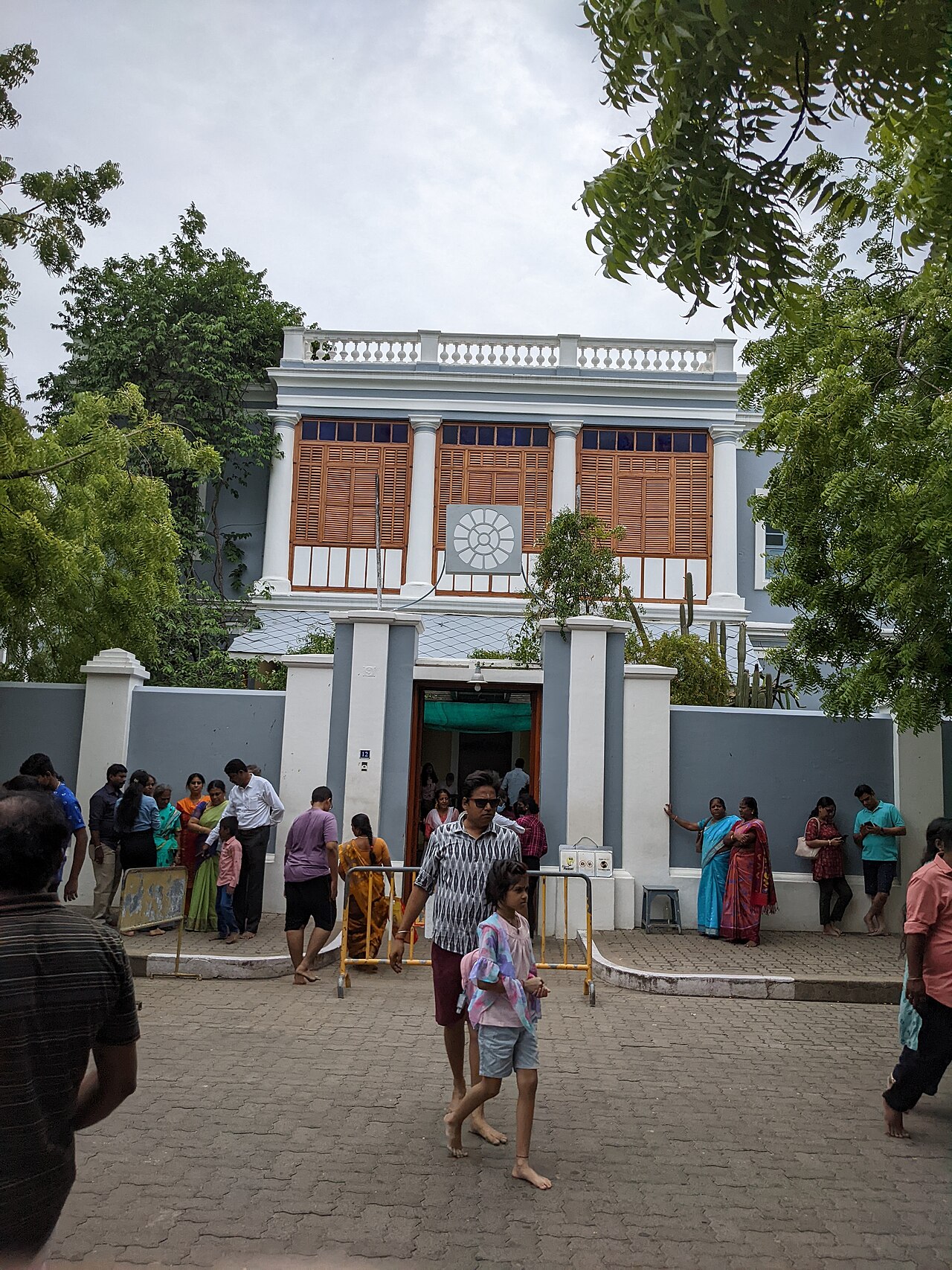
The samadhi — the joint resting place of Sri Aurobindo and Mirra Alfassa, known within the Ashram as the Mother — sits in an open courtyard under a single frangipani tree, covered daily in a fresh geometric arrangement of flowers laid directly onto the marble slab by Ashram volunteers before opening. There is no idol, no priest, and no ritual in the conventional temple sense; visitors sit or kneel at the marble edge in silence, and the courtyard's entire atmosphere is built around the absence of spectacle rather than its presence. The surrounding building, a converted French colonial residence with the same lime-washed walls and teak shutters found throughout White Town, gives no external sign of what it contains beyond the queue of visitors at its door and the request, posted at the entrance, to leave phones behind.
Mejor momento del día: 08:00 – 09:00. Shortly after opening, when the courtyard holds the fewest visitors and the flower-arrangement on the samadhi itself is freshly laid for the day.
Horario de Sri Aurobindo Ashram
- Horario
- 08:00–18:00
Mon–Sun 08:00–12:00 and 14:00–18:00 - Samadhi courtyard: 08:00 – 12:00 and 14:00 – 18:00 daily. Main building darshan days are restricted to specific dates in February, April, August, and November tied to the founders' birth and arrival anniversaries.
- Cierra los
- Abierto todos los días
Horario recopilados de sriaurobindoashram.org y registros públicos, última actualización el . Pueden cambiar sin previo aviso — confírmalos antes de viajar. Cómo escribimos estas guías
Precio de entrada de Sri Aurobindo Ashram
| Entrada | Precio |
|---|---|
| Visitantes indios | Gratis |
| Visitantes extranjeros | Gratis |
| Niños | Gratis |
| Cámara | Gratis |
Entry to the samadhi courtyard is free and unticketed. Photography and phone use are prohibited inside the courtyard itself — devices must be switched off or left with the volunteer desk at the entrance, not merely silenced. The Ashram's bookshop and the Sri Aurobindo Ashram Trust guesthouse network operate as separate, paid services.
Precios recopilados de sriaurobindoashram.org y registros públicos, última actualización el . Pueden cambiar sin previo aviso — confírmalos antes de viajar. Cómo escribimos estas guías
Mejor época para visitar Sri Aurobindo Ashram
- Quiet
- Moderate
- Busy
08:00 – 09:00
Morning OpeningBest time to go
Fewest visitors of the day; freshly laid flower arrangement on the samadhi. Volunteers are least rushed and the silence is easiest to hold.
Quiet10:00 – 12:00
Midday Group Visits
Domestic tour groups and school visits cluster in this window. Courtyard remains orderly but queue to approach the samadhi edge lengthens.
Moderate14:00 – 16:00
Afternoon Reopening
Courtyard reopens after the midday closure; visitor numbers stay light through mid-afternoon.
Quiet16:30 – 18:00
Evening Peak
The busiest window of the day as visitors combine the Ashram with an evening seafront walk. Silence is harder to maintain with larger numbers present.
Busy
Historia de Sri Aurobindo Ashram
Sri Aurobindo Ghose — Cambridge-educated, a former revolutionary against British rule turned philosopher-yogi — arrived in Pondichéry in 1910, choosing French territory specifically because it sat outside direct British colonial jurisdiction and offered him safety from prosecution. He withdrew from public political life entirely and devoted the following decades to developing Integral Yoga, a spiritual practice aimed at what he termed the evolution of consciousness rather than individual liberation alone. Mirra Alfassa, a French-born spiritual collaborator with her own independent occult and artistic background, joined him permanently in 1920 after earlier visits, and the two founded the formal Ashram together in 1926, an event still marked annually on 24 November as the Day of Siddhi.
Sri Aurobindo withdrew from public appearance after 1926, communicating primarily through written correspondence with disciples, while the Mother assumed direct day-to-day organisational leadership of the growing community — a division of labour that shaped the Ashram's structure for the rest of both their lives. Sri Aurobindo died in 1950; the Mother continued to lead the Ashram until her own death in 1973, by which point she had also founded Auroville, in 1968, as a separate but philosophically connected project. Both are interred together in the samadhi that remains the Ashram's spiritual centre.
Normas y etiqueta en Sri Aurobindo Ashram
Silence inside the samadhi courtyard is not a suggestion — Ashram volunteers, dressed plainly and stationed at the courtyard's edges, will approach anyone speaking above a whisper or attempting to photograph the samadhi itself. Phones must be switched off, not merely silenced, before entering; a small drop-off counter near the entrance holds devices for visitors who would rather not carry them at all. Shoes come off at the outer step, in line with general Indian religious-site convention, though the Ashram enforces this less aggressively than a temple would since the building was never consecrated as one.
Dress code runs conservative but not strict in the way a working temple's would be: shoulders and knees covered is the practical expectation, though no volunteer will turn a visitor away at the door for a borderline outfit the way they would for an active phone or camera. The main Ashram building beyond the samadhi courtyard is not open to casual visitors at all — access to Sri Aurobindo and the Mother's personal rooms is restricted to specific darshan days publicised in advance, typically four times a year, and even then only to those who queue from early morning.
Consejos para visitar Sri Aurobindo Ashram
- 1
The courtyard is small enough that a genuine visit takes fifteen to twenty minutes of actual sitting, not the ninety-minute circuit a major temple complex would demand — treat it as a brief, deliberate stop rather than a half-day itinerary item. Arriving at or just after the 08:00 opening avoids both the midday tour-group clusters and the late-afternoon crowd that builds before the 18:00 close.
- 2
The Ashram's associated bookshop, a short walk away on the same street, stocks Sri Aurobindo's and the Mother's writings in multiple languages and is a more productive stop than the courtyard itself for anyone wanting to understand Integral Yoga's actual philosophical content, which the silent courtyard experience does not explain on its own. The Ashram also runs a network of simple, well-maintained guesthouses across White Town — SAI International Guest House and Park Guest House among them — priced well below Puducherry's boutique-hotel market and popular enough that advance booking, sometimes weeks ahead in peak season, is genuinely necessary.
- 3
Visitors expecting a chanting, incense-heavy devotional atmosphere typical of other Indian ashrams should recalibrate: the emphasis here is closer to a Quaker meeting-house hush than to bhakti devotional practice, and arriving with that expectation set correctly changes how the fifteen minutes inside land.
Cómo llegar a Sri Aurobindo Ashram
La estrella roja es Sri Aurobindo Ashram; los pines numerados son los 5 lugares más cercanos de nuestras guías, cada uno con su clasificación en su ciudad. Toca un pin para ver más detalles.
Rue de la Marine, near the seafront, Puducherry 605002Cómo llegar en Google Maps
Desde Puducherry Railway Station
₹50–₹801.5 km · 5–10 min
Auto-rickshaw). A 15-minute walk through White Town is equally practical.
Desde Puducherry New Bus Stand (Adiyanuthala)
₹150–₹2009 km · 20–30 min
Auto-rickshaw).
Desde Auroville Visitor Centre
₹350–₹50012 km · 25–35 min
Taxi, one-way). A common combined itinerary given the philosophical link between the two sites.
Aeropuerto más cercano
Desde Chennai International Airport (MAA)
approximately 160 km, 3–3.5 hours via ECR. Puducherry Airport (PNY), 5 km away, has limited and irregular service.
Estación de tren más cercana
Desde Puducherry Railway Station
1.5 km, 5–10 minutes by auto-rickshaw or a 15-minute walk.
Preguntas frecuentes sobre Sri Aurobindo Ashram
Is photography allowed inside the Sri Aurobindo Ashram samadhi courtyard?
No. Phones and cameras must be switched off entirely, not just silenced, and a drop-off counter near the entrance is available for visitors who prefer not to carry a device inside at all. Volunteers actively enforce this rule.
Can visitors see the rooms where Sri Aurobindo and the Mother lived?
Not on a general visit. Access to their personal rooms in the main Ashram building is restricted to specific darshan days announced a few times a year — around late February, April, August, and November — and even then requires an early-morning queue.
How long does a visit to the samadhi courtyard actually take?
Fifteen to twenty minutes covers a genuine, unhurried visit — the courtyard is compact, there is no guided tour, and the appropriate pace is to sit quietly rather than circulate. It is not a half-day itinerary item.
Is there a dress code for entering the Ashram?
Shoulders and knees covered is the practical expectation, in line with general Indian religious-site norms, though enforcement is less strict than at an active temple. Shoes are removed at the outer step before entering the courtyard.
Redactado con ayuda de IA a partir de fuentes oficiales y registros públicos, y publicado solo tras las comprobaciones descritas en Cómo escribimos estas guías. Nadie de Traveliac ha visitado este lugar. Última actualización el . Cómo clasificamos y verificamos los lugares
Lugares para visitar cerca de Sri Aurobindo Ashram
Distancias en línea recta según nuestro mapa; los tiempos son estimados.
 #2 in Puducherry (Pondicherry)Entrada gratuita
Promenade Beach (Goubert Avenue)
Playa · 500 m · about 8 min walk
 #7 in Puducherry (Pondicherry)Entrada gratuita
Immaculate Conception Cathedral
Iglesia · 550 m · about 9 min walk
 #1 in Puducherry (Pondicherry)Entrada gratuita
French Quarter (White Town)
Patrimonio · 950 m · about 15 min walk
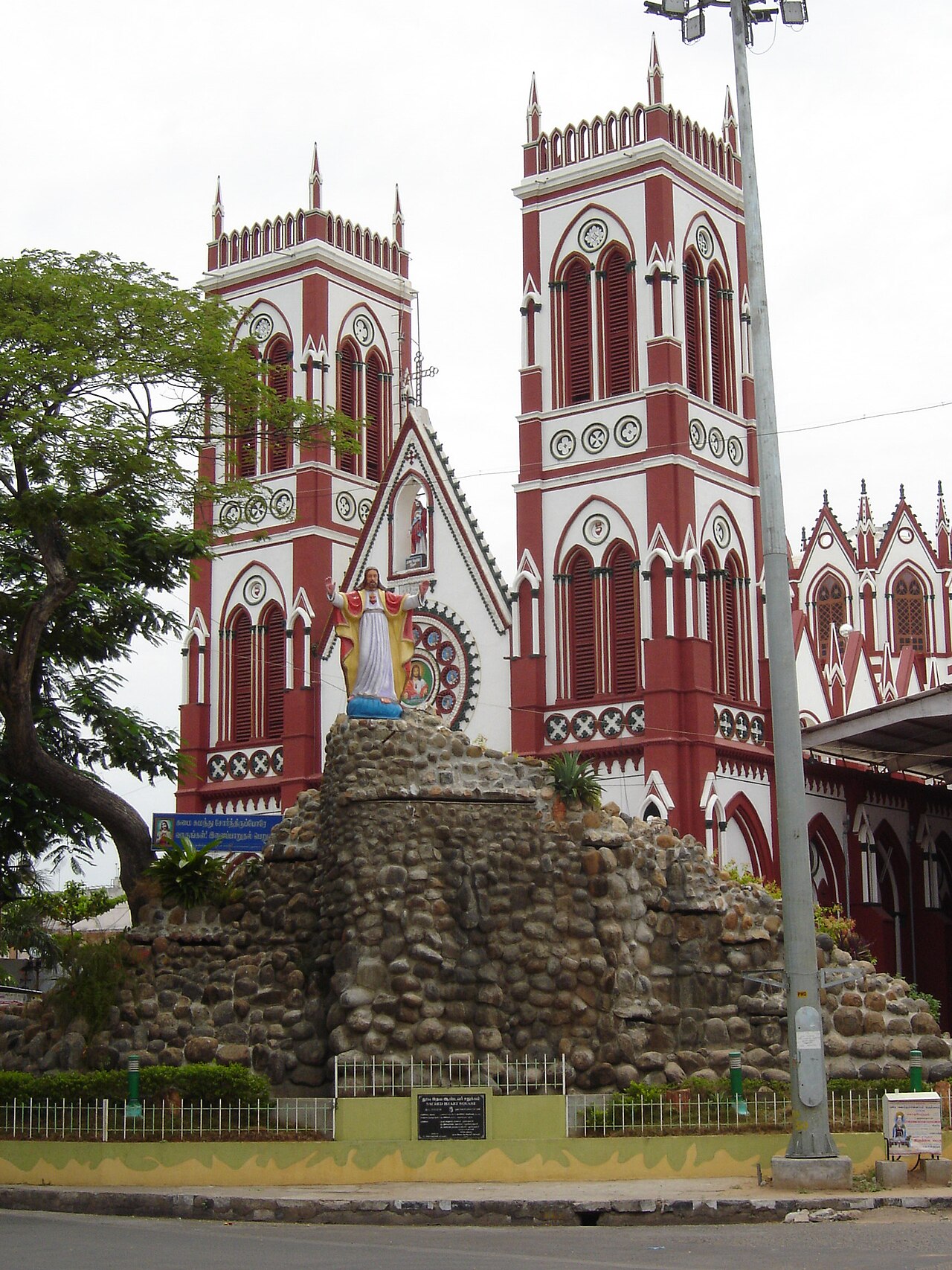 #5 in Puducherry (Pondicherry)Entrada gratuita
Basilica of the Sacred Heart of Jesus
Iglesia · 1.4 km · about 23 min walk