Acropolis & Parthenon
#1of 10 places to visit in AthensAthens, Attica, Greece
Also known as Athenian Acropolis · Akropoli Athinon
Quick answer
Opening hours: 08:00–16:00, last entry 15:30. Entry: €30. Allow 2.5 hrs. Best time: 08:00 opening or the final 90 minutes.
Updated · Compiled by Traveliac, AI-assisted · 4 min read
- Opening hours
- 08:00–16:00
- April-October: daily 08:00-18:00, last entry 17:30. November-March: daily 08:00-16:00, last entry 15:30. Shown: the shorter November-March window and its last entry. Hours extend toward 20:00 in peak midsummer on some dates; the Ministry of Culture publishes exact seasonal cut-offs a few weeks ahead each year. Closed 1 January, 25 March, 1 May, Orthodox Easter Sunday, 25 December, 26 December.
- Entry fee
- €30
- Ticket from
- Time needed
- 2.5 hrs
- Best time of day
- 08:00 opening or the final 90 minutes
- Best months
- Apr – Jun, Sep – Oct
- Address
- Acropolis of Athens, Dionysiou Areopagitou & Theorias, 10558 Athens, Greece
About Acropolis & Parthenon
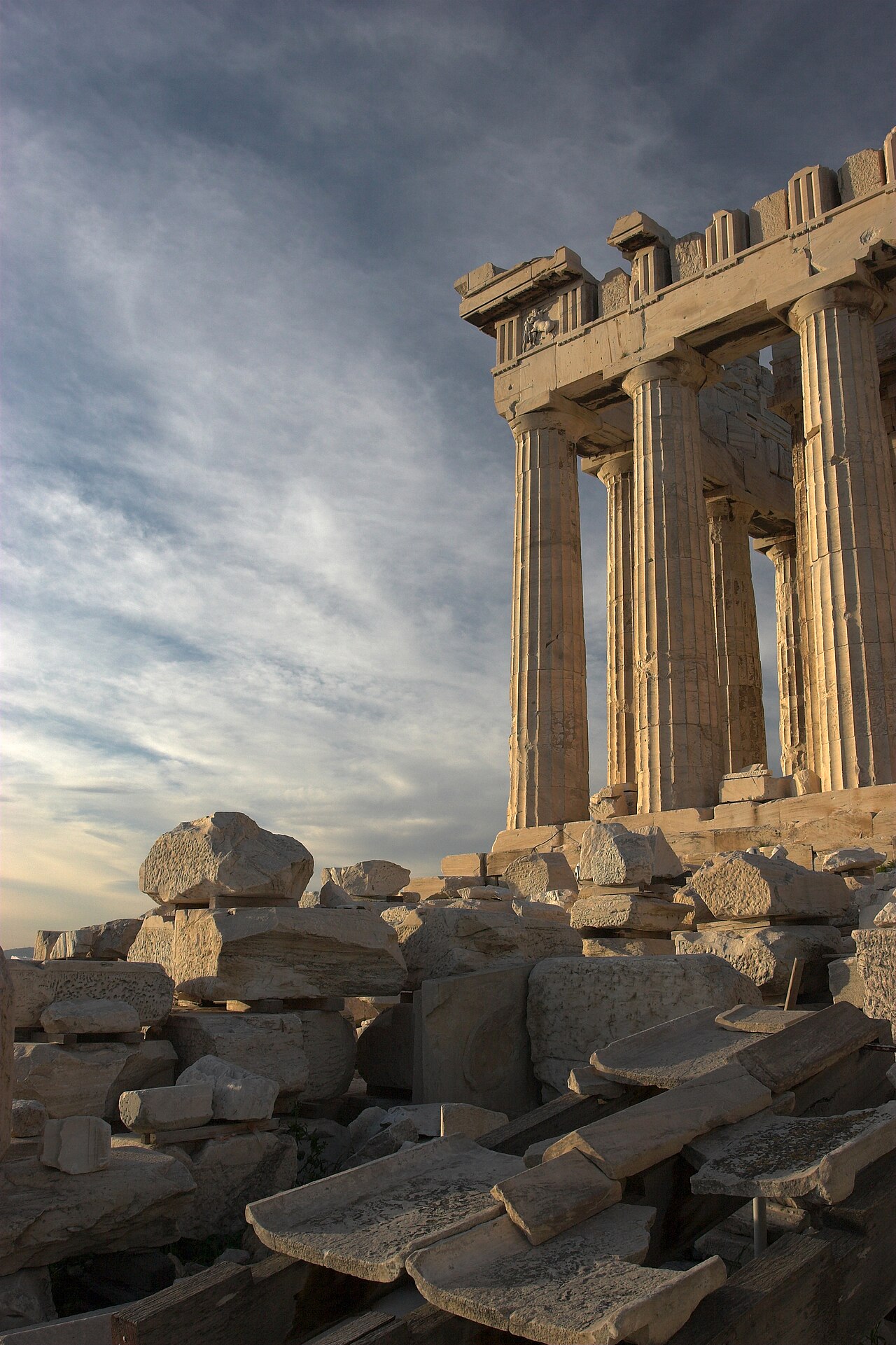
The Acropolis rises 156 metres above sea level on a limestone plateau roughly 300 metres long, and the Parthenon at its summit was built between 447 and 438 BCE using Pentelic marble quarried 18 km northeast on Mount Pentelicus. That marble carries a trace of iron oxide that oxidises to a honey colour in direct sun, which is why the temple looks white in photographs but warm gold at ground level in late afternoon. The architects Iktinos and Kallikrates worked to a design overseen by the sculptor Pheidias, and the building has almost no straight lines: the stylobate curves upward slightly toward the centre and the columns lean inward by a few centimetres, an optical correction the Greeks called entasis.
Best time of day: 08:00 opening or the final 90 minutes. Before closing. The site sits fully exposed on bare rock with no shade, and midday sun on the marble is punishing from June to August.
Acropolis & Parthenon timings
Acropolis & Parthenon opens at 08:00 and closes at 16:00. It keeps the same hours on Saturday and Sunday.
- Opening hours
- 08:00–16:00
Mon–Sun 08:00–16:00 - April-October: daily 08:00-18:00, last entry 17:30. November-March: daily 08:00-16:00, last entry 15:30. Shown: the shorter November-March window and its last entry. Hours extend toward 20:00 in peak midsummer on some dates; the Ministry of Culture publishes exact seasonal cut-offs a few weeks ahead each year. Closed 1 January, 25 March, 1 May, Orthodox Easter Sunday, 25 December, 26 December.
- Closed on
- 1 January, 25 March, 1 May, Orthodox Easter Sunday, 25 December, 26 December
Good to know: Hours extend toward 20:00 in peak midsummer on some dates; the Ministry of Culture publishes exact seasonal cut-offs a few weeks ahead each year.
Opening hours compiled from tickets.hh.gr and public records, last updated . They change without notice — confirm before you travel. How we write these guides
Acropolis & Parthenon ticket price
| Ticket | Price |
|---|---|
| Standard ticket | €30 |
| Concession (student / senior) | €15 |
| Children | Free |
Adult general admission is €30 year-round, as of 2026 — the former November–March half-price winter rate has been discontinued. EU citizens 65+ pay €15. EU citizens under 25 enter free with ID but must still reserve a zero-value timed ticket online; non-EU visitors under 25 pay the concession rate. Book at the official Hellenic Ministry of Culture portal (tickets.hh.gr) to fix an entry slot and skip the gate queue; verify current pricing at the official site before travel.
Prices compiled from tickets.hh.gr and public records, last updated . They change without notice — confirm before you travel. How we write these guides
Best time to visit Acropolis & Parthenon
- Moderate
- Busy
- Very busy
08:00 – 09:30
Opening RushBest time to go
Tour groups with pre-booked 08:00 slots cluster at the Propylaea gate; individual travellers who arrive right at opening still move through in under 15 minutes.
Moderate10:00 – 13:00
Cruise & Coach Peak
Cruise-ship shore excursions and coach tours from Piraeus concentrate here; the Parthenon's east façade viewing area can be shoulder-to-shoulder in July and August.
Very busy13:00 – 16:00
Midday Heat
Crowds stay heavy but the exposed rock surface reaches 40°C+ in summer, thinning the number of visitors willing to linger.
Busy17:00 – close
Golden Hour
Light on the marble turns amber in the final two hours; day-trippers have largely departed for dinner, leaving a calmer final window.
Moderate
History of Acropolis & Parthenon
Construction began under the Athenian statesman Pericles as part of a building programme funded partly by tribute from the Delian League, a use of allied funds that was controversial even in antiquity. The Parthenon replaced an earlier temple destroyed by the Persians in 480 BCE, and its sculptural programme — the Elgin Marbles frieze, now split between the Acropolis Museum and the British Museum in London, a division Greece formally disputes — depicted the Panathenaic procession and battles between gods and giants. The building served successively as a Byzantine church, a Catholic cathedral under Frankish rule, and an Ottoman mosque with a minaret added in the 15th century. Catastrophic damage came in 1687, when a Venetian mortar shell ignited Ottoman gunpowder stored inside the Parthenon during a siege, blowing out the central section of the structure. Restoration has been continuous since a Greek architectural service began work in 1975, and cranes are visible on-site most years as conservators reassemble fallen drums using titanium dowels rather than the original iron, which had rusted and cracked the marble.
Rules & etiquette at Acropolis & Parthenon
Flat, closed-toe shoes are effectively mandatory — the marble pathway up from the Propylaea gate has been polished to a slick sheen by millions of feet since antiquity, and sandals slip on it even in dry weather. Tripods, selfie sticks over a certain length, and drones are prohibited without a Ministry of Culture permit obtained in advance. Large backpacks must be left at the free cloakroom near the ticket office. There is no shade anywhere on the rock, and the only water fountain sits near the Propylaea entrance, so carrying a bottle is advisable given the climb. Guides operating on-site must carry a Greek National Tourism Organisation licence; freelance touts near Akropoli metro station selling ‘skip the line’ access are not affiliated with the Ministry.
Tips for visiting Acropolis & Parthenon
- 1
Timed-entry tickets sell out for the first and last slots of the day during June through September, so booking online several days ahead is worth doing even for the 08:00 slot. The southern slope path from the Odeon of Herodes Atticus is steeper but far less crowded than the main Propylaea ascent from Dionysiou Areopagitou — it is a reasonable alternate route down. The Areopagus Hill just northwest of the entrance, a bare rock outcrop free to climb, gives an unobstructed view back at the Parthenon's west façade and is a good spot to wait out a crowd surge. Tipping is not expected for site staff; licensed guides typically work for a flat fee agreed in advance rather than a gratuity.
How to reach Acropolis & Parthenon
We haven't pinned Acropolis & Parthenon's exact position yet; the map shows the other places in our Athens guide. Use the address below or the directions link.
Acropolis of Athens, Dionysiou Areopagitou & Theorias, 10558 Athens, GreeceDirections in Google Maps
From Athens International Airport (ATH)
33 km · 45-55 min
€9 single airport fare
From Piraeus Port
9 km · 30-40 min
€1.20 standard metro fare
From Syntagma Square
1.5 km · 10 min
€1.20 standard metro fare
Nearest airport
From Athens International Airport Eleftherios Venizelos (ATH)
33 km, approximately 40–50 minutes by metro Line 3 (direct, no transfer) or 45–60 minutes by road depending on Attiki Odos traffic.
Nearest station
From Akropoli metro station (Line 2, red line)
400 m, a 5-minute walk via Dionysiou Areopagitou pedestrian street.
Acropolis & Parthenon FAQs
Do I need to book Acropolis tickets in advance for 2026?
Yes, it is strongly recommended. Timed-entry slots at tickets.hh.gr, the official Hellenic Heritage portal, frequently sell out for early-morning and late-afternoon windows in peak season (June–September), and booking ahead avoids the gate queue that can run 30–45 minutes in midsummer.
Is the Acropolis free for EU citizens?
EU citizens under 25 enter free with valid ID, though a zero-value ticket still needs to be reserved online. EU citizens 65 and over pay a concession rate of €15 as of 2026. Non-EU visitors of any age pay the standard adult rate unless another concession category applies.
How much walking is involved and is it wheelchair accessible?
The main ascent from the Propylaea gate is roughly 200 metres of stepped, sloped marble path with no shade. A dedicated wheelchair lift on the north side of the rock, operated by site staff on request, provides step-free access to the summit — visitors should contact staff at the entrance to arrange its use.
What happened to the Parthenon's sculptures?
Roughly half of the surviving frieze and pediment sculptures are displayed in the Acropolis Museum at the base of the hill; the other half, removed by Lord Elgin in the early 1800s under Ottoman-era permission, are held by the British Museum in London. Greece disputes the legality of that removal and campaigns for their return.
Compiled with AI assistance from official sources and public records, and published only after the checks in How we write these guides. Nobody from Traveliac has visited this place. Last updated . How we rank and check places