Wat Thai Buddhagaya
#3of 5 places to visit in Bodh GayaBodh Gaya, Bihar
Also known as Royal Thai Monastery · Thai Temple Bodh Gaya · Wat Thai Bodhgaya
Quick answer
Opening hours: 06:00–12:00 and 14:00–18:00. Entry is free. Allow 30 min. Best time: 7:00 AM – 8:30 AM.
Updated · Compiled by Traveliac, AI-assisted · 4 min read
- Opening hours
- 06:00–18:00
- Entry fee
- Free
- Time needed
- 30 min
- Best time of day
- 7:00 AM – 8:30 AM
- Best months
- Oct – Feb
- Address
- Buddha Marg (Bodh Gaya–Gaya Road), approximately 800 metres north of the Mahabodhi Temple Complex, Bodh Gaya, Gaya District, Bihar 824231
About Wat Thai Buddhagaya
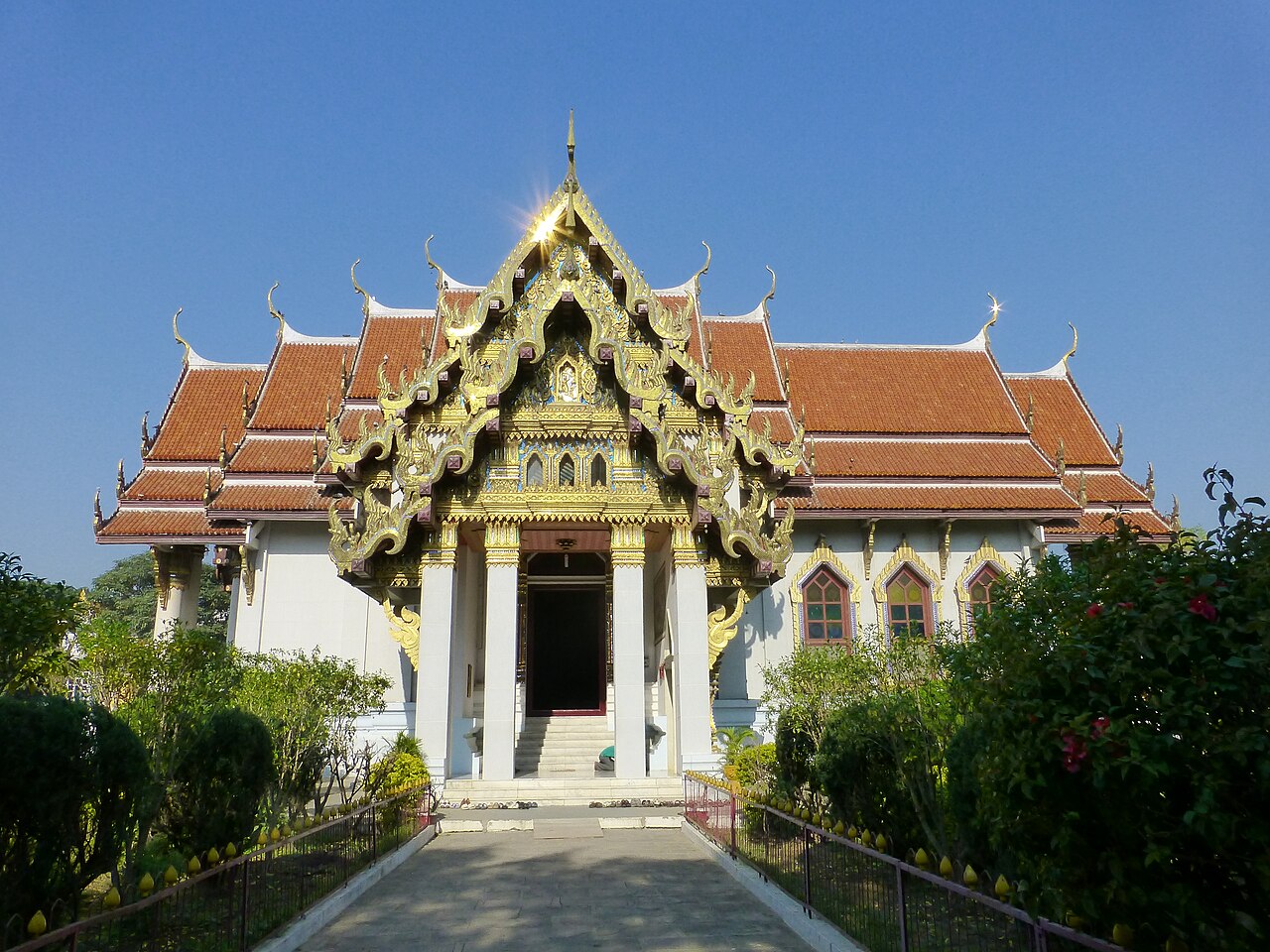
Wat Thai Buddhagaya announces itself from the road with a triple-tiered, steeply raked roof sheathed in green ceramic tile and gold trim, its ridge lines finished in gilded naga serpent finials that curl skyward at each corner — an unmistakable transplant of central Thai temple architecture onto the flat Bihar plain. It was the first monastery built by a foreign Buddhist nation at Bodh Gaya in the modern era, predating by decades the wave of Japanese, Tibetan, and Bhutanese construction that followed. The shrine hall interior holds a large gilded bronze Buddha image cast in Bangkok and shipped to Bihar for the consecration; a separate 25-metre outdoor Buddha statue, added to the grounds later, is visible above the monastery's boundary wall from the main road and has become a secondary landmark for orienting the walk between the Mahabodhi Temple and the Thai, Bhutanese, and Chinese monastery cluster to its north.
Best time of day: 7:00 AM – 8:30 AM. After the morning chanting session has finished but before tour coaches arrive. The gilt roofline catches direct morning light and the garden is close to empty.
Wat Thai Buddhagaya timings
Wat Thai Buddhagaya is open 06:00–12:00 and 14:00–18:00. It keeps the same hours on Saturday and Sunday.
- Opening hours
- 06:00–18:00
Mon–Sun 06:00–12:00 and 14:00–18:00 - Closed on
- Open every day
Good to know: Morning and evening chanting sessions (roughly 6:30 AM and 5:30 PM) are open for lay visitors to sit in on. The midday closure corresponds to the monks' meal and rest period and is observed strictly regardless of season.
Opening hours compiled from en.wikipedia.org and public records, last updated . They change without notice — confirm before you travel. How we write these guides
Wat Thai Buddhagaya ticket price
| Ticket | Price |
|---|---|
| Indian visitors | Free |
| Foreign visitors | Free |
| Children | Free |
| Camera | Free |
No entry fee or camera charge at any point. Donation boxes are placed near the main shrine hall for visitors who wish to contribute toward monastery upkeep; contribution is entirely voluntary and no monk or attendant solicits a fixed amount. The garden Buddha statue and grounds may be photographed freely; photography inside the shrine hall during active chanting is discouraged out of respect for meditating monks rather than by formal rule.
Prices compiled from en.wikipedia.org and public records, last updated . They change without notice — confirm before you travel. How we write these guides
Best time to visit Wat Thai Buddhagaya
- Quiet
- Moderate
6:00 AM – 8:30 AM
Morning ChantingBest time to go
Resident monks complete their morning chanting session; a handful of lay visitors sit quietly at the rear of the hall. The garden and gilded roofline are at their most photogenic in the low morning light.
Quiet8:30 AM – 12:00 PM
Circuit Traffic
Walking-circuit visitors moving between the Mahabodhi Temple and the monastery cluster pass through steadily. Tour groups on fixed Bodh Gaya itineraries begin arriving from around 10:00 AM.
Moderate12:00 PM – 2:00 PM
Midday Closure
The monastery observes its meal and rest period; the shrine hall is generally closed to casual visitors during this window, though the garden gate is not physically barred.
Quiet2:00 PM – 6:00 PM
Afternoon and Evening Chanting
Reopens after the midday break. A second chanting session in the early evening draws a modest number of pilgrims; the outdoor Buddha statue catches good backlight before the 6:00 PM close.
Moderate
History of Wat Thai Buddhagaya
The monastery was established in 1956 at the invitation of Prime Minister Jawaharlal Nehru, who sought to mark the 2,500th anniversary of the Buddha's parinirvana (the Buddha Jayanti) with a gesture of pilgrimage-circuit diplomacy between India and Thailand. Construction proceeded through the late 1950s under Thai royal patronage, making it the earliest of Bodh Gaya's now-numerous national monasteries and the model that later Japanese, Bhutanese, and Tibetan missions studied when planning their own compounds. In a coincidence often mentioned by resident monks, 1956 was also the year King Bhumibol Adulyadej briefly entered monkhood in Thailand for a fortnight, a devotional gesture tied to the same 2,500-year commemoration. The monastery has been renovated and re-gilded multiple times since, most visibly to the roof tiles and the naga finials, which weather quickly in Bihar's humidity and require periodic replacement funded by the Thai government and lay donors.
Rules & etiquette at Wat Thai Buddhagaya
Shoes come off at the base of the shrine hall steps, at a rack separate from — and unrelated to — the shoe counter at the Mahabodhi Temple half a kilometre away; carrying temple footwear tags between sites causes confusion and is worth avoiding. Silence is expected inside the hall whenever a chanting session is underway, whether or not a sign says so; monks do not interrupt their practice to ask latecomers to quiet down, they simply continue, which visitors sometimes mistake for indifference rather than discipline. Shoulders and knees should be covered; the monastery does not turn visitors away for casual dress but robed attendants will offer a wrap shawl at the door if clothing is judged too brief. Flash photography of the main gilded image is discouraged, and photographing individual monks at close range without asking first is a common friction point — a nod and a raised camera is generally read correctly, but assume permission is required rather than implied.
Tips for visiting Wat Thai Buddhagaya
- 1
The Thai monastery sits at the northern end of the international monastery cluster, making it a logical first or last stop on a walking circuit that also takes in the Bhutanese and Chinese (Ta Hua Chi) temples nearby and continues on foot to the Tibetan monastery and Japanese temple further out. Budget 30 minutes here specifically, since the garden and outdoor statue reward a slower look than the shrine hall alone. December and January bring the heaviest crowding of the entire monastery belt, driven by the Dalai Lama's Kalachakra teaching season at the nearby Kalachakra Maidan — traffic on Buddha Marg backs up with tour buses and the monastery's own courtyard fills with overflow pilgrims during this window, so an October or February visit gives a materially quieter experience of the architecture. Touts occasionally station themselves near the monastery gate offering unofficial 'guided tours' of the grounds for a negotiated fee; the monastery itself charges nothing and posts no legitimate guide service, so politely declining costs nothing.
How to reach Wat Thai Buddhagaya
The red star is Wat Thai Buddhagaya; the numbered pins are the 2 nearest places in our guides, each showing its rank in its city. Tap a pin for details.
Buddha Marg (Bodh Gaya–Gaya Road), approximately 800 metres north of the Mahabodhi Temple Complex, Bodh Gaya, Gaya District, Bihar 824231Directions in Google Maps
From Mahabodhi Temple Complex
0.8 km · 10–12 min
Free
From Gaya Junction Railway Station
₹100–₹15014 km · 30–35 min
Negotiated
From Gaya International Airport (GAY)
₹120–₹2009 km · 18–22 min
Nearest airport
From Gaya International Airport (GAY)
9 km, approximately 20 minutes by auto-rickshaw
Nearest railway station
From Gaya Junction Railway Station
14 km, approximately 30–35 minutes by auto-rickshaw
Wat Thai Buddhagaya FAQs
Is there an entry fee for Wat Thai Buddhagaya?
No. Entry is free for all visitors regardless of nationality or religion. Donation boxes near the shrine hall accept voluntary contributions toward monastery upkeep, but nothing is required or solicited.
Why was a Thai monastery built at Bodh Gaya in 1956, before most other national monasteries?
It was established at Prime Minister Jawaharlal Nehru's invitation to mark the 2,500th anniversary of the Buddha's parinirvana (Buddha Jayanti). Thailand's was the first foreign-government-funded monastery built at Bodh Gaya in the modern era, and its 1950s construction predates the Japanese, Tibetan, Bhutanese, and other national monasteries that followed over subsequent decades.
Can visitors watch or join the chanting sessions?
Yes. Lay visitors are welcome to sit quietly at the rear of the shrine hall during the roughly 6:30 AM and 5:30 PM chanting sessions. Silence is expected throughout — arriving or leaving mid-session should be done as unobtrusively as possible.
When should this monastery be avoided due to crowding?
December and January, when the Dalai Lama's Kalachakra teachings draw large Tibetan Buddhist gatherings to nearby Kalachakra Maidan, bring heavy tour-bus traffic to the entire monastery belt including Wat Thai. October, November, and February offer a comparably active pilgrimage atmosphere with far less congestion.
Compiled with AI assistance from official sources and public records, and published only after the checks in How we write these guides. Nobody from Traveliac has visited this place. Last updated . How we rank and check places
Places to visit near Wat Thai Buddhagaya
Straight-line distances from our map; times are estimates.