Tsuglagkhang Complex
#2of 8 places to visit in DharamshalaDharamshala, Himachal Pradesh
Also known as Dalai Lama Temple · Central Cathedral · Thekchen Chöling
Quick answer
Opening hours: 06:00–18:00. Entry is free. Allow 1.5 hrs. Best time: 07:00 – 09:00.
Updated · Compiled by Traveliac, AI-assisted · 5 min read
- Opening hours
- 06:00–18:00
- Seasonal hours. November to March: 06:00-18:00. April to October: 05:00-19:00. The days window shows the narrower November-March hours. Access is restricted or the complex is closed to the public entirely during His Holiness the Dalai Lama's public teachings and on days he is in residence for private audiences. The Tibetan Branch Security Office posts notices at the gate a few days in advance.
- Entry fee
- Free
- Time needed
- 1.5 hrs
- Best time of day
- 07:00 – 09:00
- Best months
- Mar – Jun, Sep – Nov
- Address
- Temple Road, McLeod Ganj, Dharamshala, Kangra district, Himachal Pradesh 176219
About Tsuglagkhang Complex
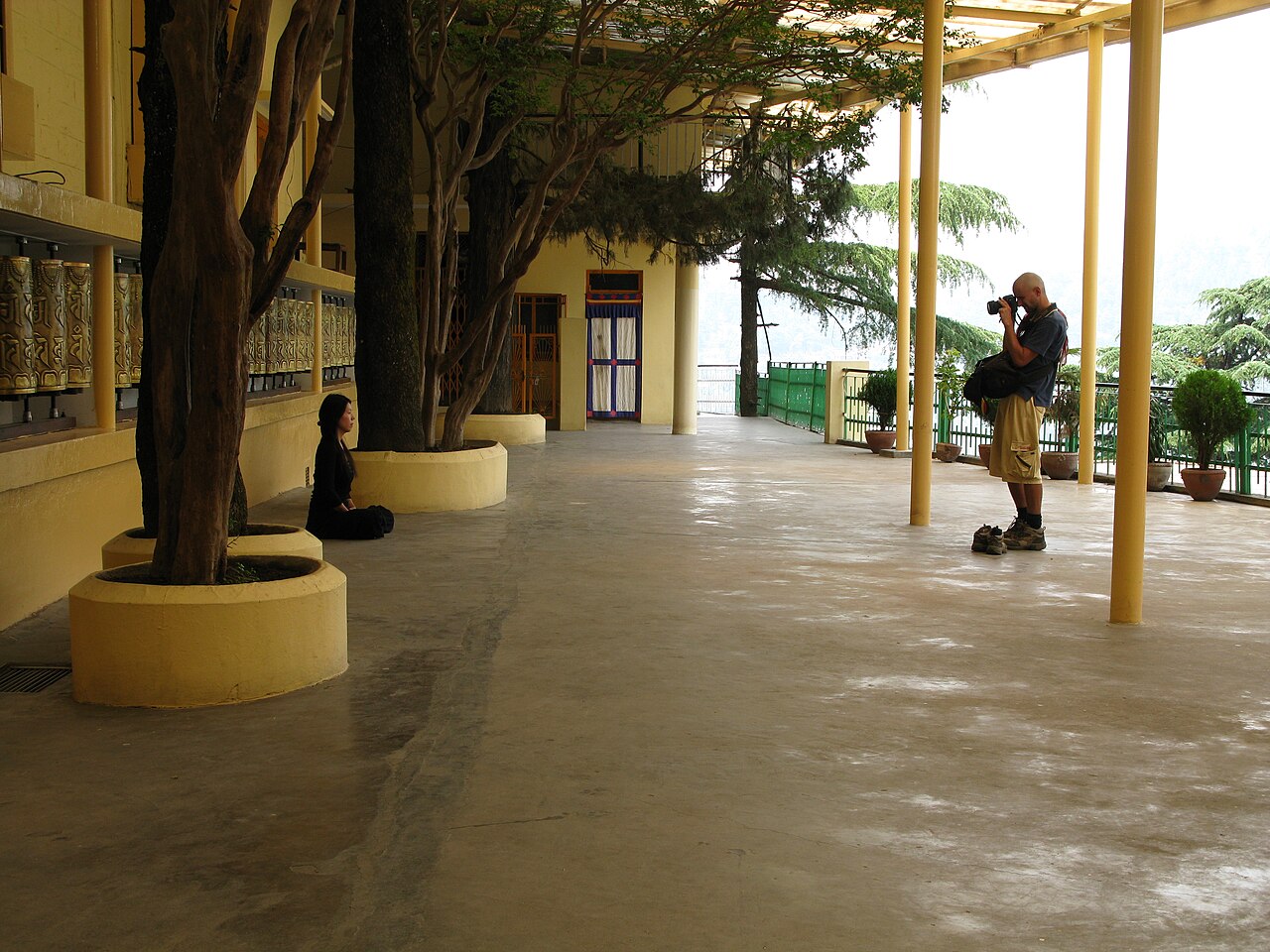
Tsuglagkhang Complex occupies the terminus of Temple Road in McLeod Ganj and functions as the residence compound and central place of worship for the 14th Dalai Lama since 1960. The complex is free to enter and holds three distinct spaces under one boundary wall: the main Tsuglagkhang assembly hall with its 3-metre gilded statue of Buddha Shakyamuni flanked by Padmasambhava and Avalokiteshvara, the separate Kalachakra Temple with its wheel-of-time mandala murals, and the Tibet Museum documenting the 1959 exodus. The compound sits on the exposed western edge of the McLeod Ganj ridge, and the covered kora path that rings its perimeter gives an uninterrupted view down into the Kangra Valley on a clear morning. Prayer wheels line roughly half the circuit, each one turned clockwise by passing pilgrims, many of them elderly refugees who walk the full loop multiple times before breakfast.
Best time of day: 07:00 – 09:00. When resident monks and elderly Tibetan pilgrims perform the kora circumambulation and the morning light hits the golden roof finials of the main hall.
Tsuglagkhang Complex timings
Tsuglagkhang Complex opens at 06:00 and closes at 18:00. Those hours hold on Saturday and Sunday too.
- Opening hours
- 06:00–18:00
Mon–Sun 06:00–18:00 - Seasonal hours. November to March: 06:00-18:00. April to October: 05:00-19:00. The days window shows the narrower November-March hours. Access is restricted or the complex is closed to the public entirely during His Holiness the Dalai Lama's public teachings and on days he is in residence for private audiences. The Tibetan Branch Security Office posts notices at the gate a few days in advance.
- Closed on
- Open every day
Good to know: Access is restricted or the complex is closed to the public entirely during His Holiness the Dalai Lama's public teachings and on days he is in residence for private audiences; the Tibetan Branch Security Office posts notices at the gate a few days in advance.
Opening hours compiled from dalailama.com and public records, last updated . They change without notice — confirm before you travel. How we write these guides
Tsuglagkhang Complex ticket price
| Ticket | Price |
|---|---|
| Indian visitors | Free |
| Foreign visitors | Free |
| Children | Free |
| Camera | Free |
The temple courtyards, main assembly hall, and Kalachakra Temple are free to enter for all visitors. The Tibet Museum wing within the same complex charges a separate small fee for foreign visitors (around ₹20 as of 2026, verify at the counter) while Indian nationals enter free; the museum is generally closed on Mondays and select Tibetan and Indian holidays.
Prices compiled from dalailama.com and public records, last updated . They change without notice — confirm before you travel. How we write these guides
Best time to visit Tsuglagkhang Complex
- Quiet
- Moderate
- Busy
05:00 – 08:00
Pilgrim KoraBest time to go
Mostly elderly Tibetan residents walking the circumambulation path; the assembly hall itself sees only a trickle of visitors. Quietest and most devotional window of the day.
Quiet09:00 – 12:00
Morning Tour Groups
Day-trip groups from Dharamshala and domestic tourists arrive; queues form at the security checkpoint but move steadily.
Moderate12:00 – 15:00
Midday Lull
Many groups break for lunch in McLeod Ganj's bazaar; the courtyard and Tibet Museum are at their calmest for unhurried viewing.
Quiet15:00 – 18:00
Afternoon Debate Sessions
Monk debate sessions draw both pilgrims and photographers to the adjoining monastery courtyard; the main complex sees its second daily peak before evening closing.
Busy
History of Tsuglagkhang Complex
The Dalai Lama and a small group of officials crossed into India in March 1959 following the failed Tibetan uprising against Chinese rule in Lhasa, and the Indian government under Jawaharlal Nehru granted the Tibetan government-in-exile use of the then largely vacant British-era hill station of McLeod Ganj from 1960 onward. Construction of the Tsuglagkhang assembly hall followed within the decade, built with donated funds from the Tibetan exile community and international supporters rather than any single state patron.
Tsuglagkhang Complex has been expanded twice since: the Kalachakra Temple was added to host the Kalachakra initiation ceremonies that the Dalai Lama periodically confers, and the Tibet Museum opened later as a dedicated archive of photographs, oral testimony, and documents from the 1950s occupation and the subsequent exile. The Namgyal Monastery — the Dalai Lama's personal monastic order, itself founded in Lhasa in the 1560s — maintains the assembly hall's daily rituals and shares the same walled compound, though it is administered as a separate monastic institution.
Rules & etiquette at Tsuglagkhang Complex
Security screening at the outer gate is mandatory and includes a metal detector and bag check; large backpacks and tripods are typically asked to be left at the checkpoint counter. Shoes come off before entering the main assembly hall and the Kalachakra Temple — a free shoe-rack operates at each threshold, not a single central counter, so track which door you used.
Photography is permitted in the courtyards and kora path but restricted inside the inner sanctum of the main hall during active prayer sessions; look for the posted sign at each doorway rather than assuming a blanket rule. Modest dress (covered shoulders and knees) is expected throughout, and voices are kept low near the prayer wheel corridor, which functions as active devotional space rather than a photo backdrop. Registration for any public teaching by His Holiness is handled exclusively through the Tibetan Branch Security Office near Hotel Tibet, three days ahead, with a passport or valid photo ID and a nominal ₹10 service fee — anyone selling teaching tickets elsewhere is not legitimate.
Tips for visiting Tsuglagkhang Complex
- 1
Visit before 09:00 to see the kora at its most active and to avoid the mid-morning arrival of day-tour groups from Dharamshala and Kangra. The Tibet Museum, a short walk inside the same compound, is easy to miss because its entrance is set back from the main courtyard — it is worth the extra 30–40 minutes for the exodus photography archive alone.
- 2
Combine the visit with Namgyal Monastery's debate courtyard, reachable through the same complex, where monks hold animated philosophical debate sessions most afternoons — ask the gate staff for the current schedule since it shifts with the academic term. A small stall just outside the main gate sells butter tea and Tibetan bread (tingmo) for under ₹50, a useful stop after the pre-dawn kora in winter when temperatures at this altitude sit close to freezing.
How to reach Tsuglagkhang Complex
We haven't pinned Tsuglagkhang Complex's exact position yet; the map shows the other places in our Dharamshala guide. Use the address below or the directions link.
Temple Road, McLeod Ganj, Dharamshala, Kangra district, Himachal Pradesh 176219Directions in Google Maps
From McLeod Ganj main square
1 km · 10–15 min walk
Free (walking); ₹50–₹80 by shared auto if arriving with luggage
From Dharamshala Bus Stand (lower town)
₹15–₹2010 km · 35–45 min
Bus) plus a 10-minute walk
From Kangra Airport, Gaggal (DHM)
₹700–₹95019 km · 40–50 min
Prepaid taxi
Nearest airport
From Kangra Airport, Gaggal (DHM)
approximately 19 km, 40–50 minutes by road.
Nearest railway station
From Chamunda Marg, Kangra Valley narrow-gauge line
approximately 22 km. Nearest broad-gauge station: Pathankot Junction – approximately 90 km.
Tsuglagkhang Complex FAQs
Is entry to the Tsuglagkhang Complex free?
Yes, entry to the temple courtyards, main assembly hall, and Kalachakra Temple is free for both Indian and foreign visitors. Only the attached Tibet Museum charges a small fee, and only to foreign nationals (around ₹20 as of 2026, verify at the counter).
Can visitors see the Dalai Lama during a normal visit?
No, not on an ordinary day — the complex is his residence and working temple, not a viewing gallery. Public sightings occur only during announced teachings or public audiences, which require advance registration through the Tibetan Branch Security Office with photo ID.
What is the difference between the Tsuglagkhang Complex and Namgyal Monastery?
They share the same walled compound on Temple Road, but Tsuglagkhang refers to the temple buildings and museum open to general visitors, while Namgyal Monastery is the resident monastic institution — the community of nearly 200 monks who maintain the daily rituals and hold the debate courtyard sessions.
Do I need to remove my shoes to enter?
Yes, shoes must be removed before entering the main assembly hall and the Kalachakra Temple. Free shoe racks operate at each building's threshold rather than one central counter for the whole complex.
Compiled with AI assistance from official sources and public records, and published only after the checks in How we write these guides. Nobody from Traveliac has visited this place. Last updated . How we rank and check places