Castel Sant'Angelo
#8of 8 places to visit in RomeRome, Lazio, Italy
Also known as Mausoleum of Hadrian · Mausoleo di Adriano
Quick answer
Opening hours: 09:00–19:30, closed Mondays, last entry 18:00. Entry: €16. Allow 1.5 hrs. Best time: 09:00–10:30.
Updated · Compiled by Traveliac, AI-assisted · 5 min read
- Opening hours
- 09:00–19:30
- Closed Mondays
- Entry fee
- €16
- Ticket from
- Time needed
- 1.5 hrs
- Best time of day
- 09:00–10:30
- Best months
- Apr – Jun, Sep – Oct
- Address
- Lungotevere Castello, 50, 00193 Roma RM, Italy
About Castel Sant'Angelo
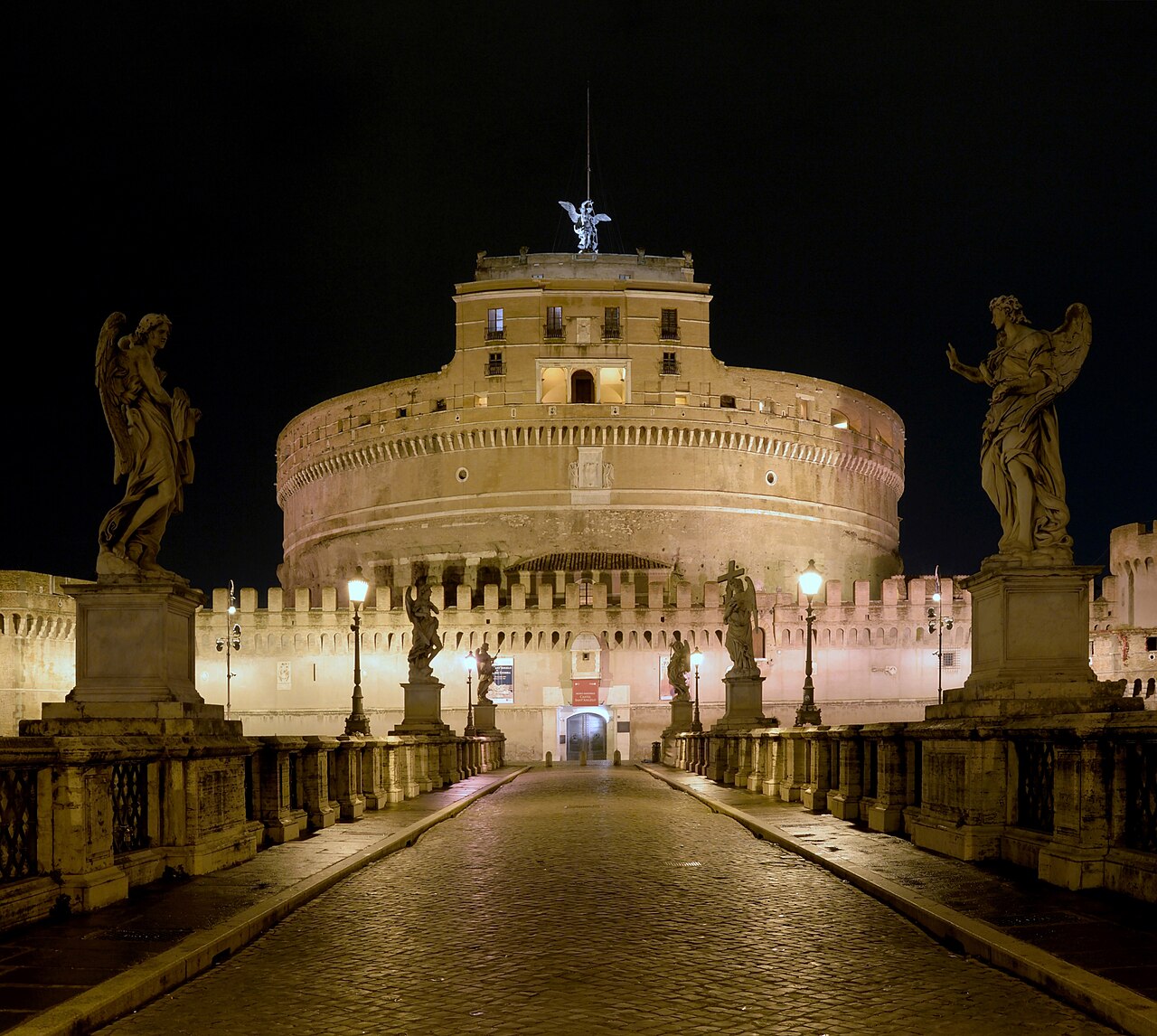
Castel Sant'Angelo charges €16 for adult admission, as of 2026, and began as Emperor Hadrian's personal mausoleum, completed in 139 CE, a year after his death, as a cylindrical drum of brick-faced concrete originally clad in travertine and topped by a garden and a bronze quadriga statue, none of which survive in original form. The structure's core — a massive circular tumulus over 60 metres across — still forms the building's base beneath the medieval and Renaissance fortress layers added over the following 1,800 years. A covered elevated corridor, the Passetto di Borgo, connects the castle directly to Vatican City roughly 800 metres away, built in the 13th century as an emergency escape route for popes; Clement VII famously used it during the 1527 Sack of Rome to flee an invading army. The castle's upper terrace, beneath the bronze Archangel Michael statue that gives the building its current name, is one of the highest publicly accessible viewpoints in central Rome.
Best time of day: 09:00–10:30. At opening, for the terrace views over the Tiber and St. Peter's dome without the midday haze and crowd buildup.
Castel Sant'Angelo timings
Castel Sant'Angelo opens at 09:00 and closes at 19:30. Those hours hold on Saturday and Sunday too.
- Opening hours
- 09:00–19:30
Monday Closed Tue–Sun 09:00–19:30 - Tuesday–Sunday 09:00–19:30, last admission 18:00.
- Closed on
- Monday, 1 January, 25 December
Good to know: Summer evening openings (early July–early September) extend hours to around 01:00 on select nights; confirm exact dates each season.
Opening hours compiled from castelsantangelo.cultura.gov.it and public records, last updated . They change without notice — confirm before you travel. How we write these guides
Castel Sant'Angelo ticket price
| Ticket | Price |
|---|---|
| Standard ticket | €16 |
| Concession (student / senior) | €2 |
| Children | Free |
€16 full-price adult ticket at the counter and online via CoopCulture with a timed slot, as of 2026. EU citizens aged 18–25 pay €2; under-18s free. Free on the first Sunday of every month. Book through castelsantangelo.cultura.gov.it or CoopCulture to avoid resale markups. As of 2026, verify current pricing at the official site before travel.
Prices compiled from castelsantangelo.cultura.gov.it and public records, last updated . They change without notice — confirm before you travel. How we write these guides
Best time to visit Castel Sant'Angelo
- Quiet
- Moderate
- Busy
09:00–10:30
Morning OpeningBest time to go
Quietest entry window; the spiral ramp and lower Roman chambers are calm before tour groups arrive.
Quiet10:30–13:30
Midday Peak
Combined Vatican-area visitors add to castle numbers; upper terraces get busiest around this window.
Busy13:30–16:30
Afternoon
Crowds ease somewhat; papal apartments and interior galleries remain comfortable to view.
Moderate16:30–19:30
Late Afternoon
Fewest visitors of the open hours; good light for terrace photography over the Tiber before last admission at 18:00.
Quiet
History of Castel Sant'Angelo
Hadrian designed the mausoleum for himself and his successors, and it held the ashes of Roman emperors from Hadrian through Caracalla, spanning roughly 139 to 217 CE, before later emperors were buried elsewhere. The building's transformation from tomb to fortress began in 401 CE, when Emperor Honorius incorporated it into Rome's Aurelian Walls as a defensive strongpoint against the deteriorating security of the late Western Empire.
The name Castel Sant'Angelo dates to 590 CE, according to tradition, when Pope Gregory the Great reported a vision of the Archangel Michael sheathing his sword atop the building, interpreted as a sign that a plague afflicting Rome had ended; a chapel and later a bronze statue commemorate the vision, though the precise historicity of the account, as with much of this period, rests on later hagiography rather than contemporary record.
Successive popes converted the fortress into a papal residence and prison from the medieval period onward, adding the Renaissance-era papal apartments still decorated with frescoes attributed to Perino del Vaga and his workshop. The composer Giacomo Puccini used the castle as the setting for the final act of his 1900 opera Tosca, in which the heroine leaps from its ramparts — a scene that has made the terrace a minor pilgrimage site for opera enthusiasts independent of its historical significance.
Rules & etiquette at Castel Sant'Angelo
The visitor route follows a spiral ramp up through the original Roman core before reaching the medieval and Renaissance floors — this ramp has an uneven ancient surface and no separate accessible route for much of its length, a genuine consideration for visitors with mobility limitations.
The upper terraces are open-air and largely unshaded; the parapet walls are original historic stonework and climbing on them for photographs is prohibited and monitored by museum staff.
Photography without flash is generally permitted throughout, including the papal apartments, though tripods require the same Ministry of Culture permit as at other state-run sites in Rome.
Tips for visiting Castel Sant'Angelo
- 1
The Ponte Sant'Angelo, the pedestrian bridge crossing the Tiber directly in front of the castle, is lined with ten Bernini-workshop angel statues (mostly executed by assistants to Bernini's designs) and offers one of the best free photograph angles of the fortress itself, particularly at sunset.
- 2
Combine a visit with the walk along the Passetto di Borgo's route toward St. Peter's Square — the corridor itself is not always open to the public, but its raised brick arcade is visible and walkable alongside at street level, tracing the same 800-metre escape route popes once used.
- 3
The rooftop terrace café, when open, is a reasonably priced break point given the premium pricing typical of similarly located Rome viewpoints; check seasonal opening since it does not always operate outside peak months. The castle sits close enough to St. Peter's Basilica (roughly 900 metres) to combine both into a single Vatican-area itinerary.
How to reach Castel Sant'Angelo
The red star is Castel Sant'Angelo; the numbered pins are the 7 nearest places in our guides, each showing its rank in its city. Tap a pin for details.
Lungotevere Castello, 50, 00193 Roma RM, ItalyDirections in Google Maps
From Rome Fiumicino Airport (FCO)
31 km · 55-75 min
€14 train + €1.50 metro
From Lepanto Metro Station (Line A)
0.8 km · 10 min
Free
From St. Peter's Square
0.9 km · 12-15 min
Free
Nearest airport
From Rome Fiumicino (FCO)
31 km, approximately 45–65 minutes by road or train-plus-transfer.
Nearest station
From Lepanto (Metro Line A)
10-minute walk, or Ottaviano–San Pietro (Metro Line A) – 15-minute walk.
Castel Sant'Angelo FAQs
What was Castel Sant'Angelo originally built for?
Emperor Hadrian built it as a mausoleum for himself and his imperial successors, completed in 139 CE. It held the ashes of Roman emperors for roughly 80 years before being converted into a military fortress in the early 5th century.
Is Castel Sant'Angelo connected to the Vatican?
Yes, by the Passetto di Borgo, a fortified elevated corridor roughly 800 metres long built in the 13th century as an emergency escape route for popes, most famously used by Pope Clement VII during the 1527 Sack of Rome.
Is Castel Sant'Angelo free on the first Sunday of the month?
Yes, admission is free on the first Sunday of every month, as of 2026, alongside the standard reduced rate of €2 for EU citizens aged 18-25 and free entry for under-18s.
Why is the castle named after an angel?
Tradition holds that Pope Gregory the Great saw a vision of the Archangel Michael sheathing his sword atop the building in 590 CE, taken as a sign that a plague in Rome had ended; a bronze angel statue has topped the fortress since, though the vision itself is legend rather than documented fact.
Compiled with AI assistance from official sources and public records, and published only after the checks in How we write these guides. Nobody from Traveliac has visited this place. Last updated . How we rank and check places
Places to visit near Castel Sant'Angelo
Straight-line distances from our map; times are estimates.