Natural History Museum
#9of 10 places to visit in LondonLondon, England, United Kingdom
Also known as NHM London
Quick answer
Opening hours: 10:00–17:50, last entry 17:30. Entry is free. Allow 2.5 hrs. Best time: 10:00.
Updated · Compiled by Traveliac, AI-assisted · 5 min read
- Opening hours
- 10:00–17:50
- Entry fee
- Free
- Time needed
- 2.5 hrs
- Best time of day
- 10:00
- Best months
- May – Jul, Sep
- Address
- Cromwell Road, London SW7 5BD
About Natural History Museum
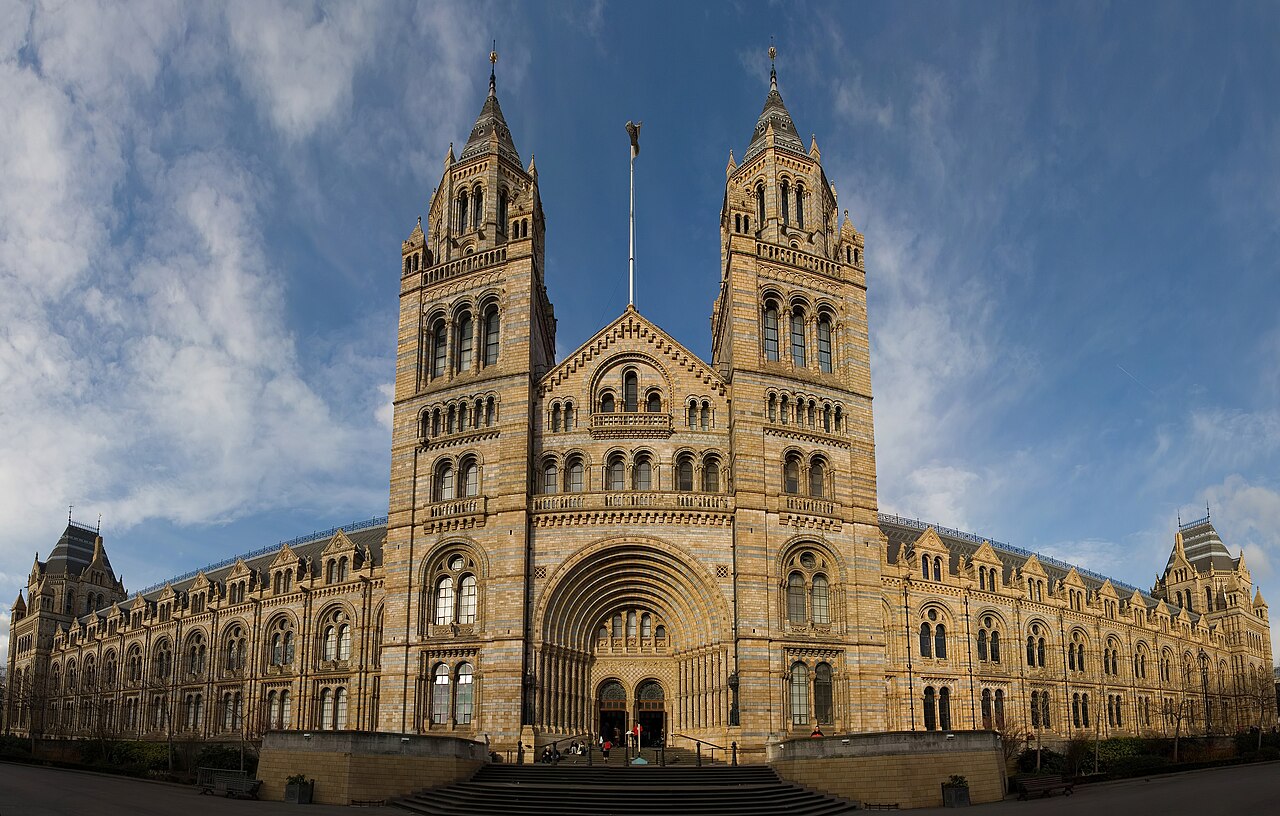
The Natural History Museum holds around 80 million specimens across botany, entomology, mineralogy, palaeontology, and zoology, displayed inside a Romanesque Revival building faced in cream and blue-grey terracotta, chosen by founding director Richard Owen as a fireproof, washable material suited to a working scientific institution. Opened in 1881, the building was designed by architect Alfred Waterhouse, whose terracotta ornamentation extends to hundreds of sculpted animal and plant motifs across the facade and Hintze Hall, organised so that living species appear on the east side of the building and extinct ones on the west. Hintze Hall, the cathedral-like central hall, has held a 25.2-metre blue whale skeleton nicknamed Hope suspended from the ceiling since 2017, replacing the cast diplodocus skeleton nicknamed Dippy that had occupied the space since 1979 and now tours the UK on loan to regional museums. The Museum's working scientific role continues alongside its public galleries: roughly 300 scientists are employed on site, and the Darwin Centre's Cocoon building houses a working specimen collection visible to visitors through glass walls.
Best time of day: 10:00. At opening, before school groups arrive in volume by mid-morning; the Hintze Hall entrance area and Dinosaurs gallery are consistently the most congested spaces by late morning.
Natural History Museum timings
Natural History Museum opens at 10:00 and closes at 17:50. It keeps the same hours on Saturday and Sunday.
- Opening hours
- 10:00–17:50
Mon–Sun 10:00–17:50 - Closed on
- 24-26 December
Opening hours compiled from nhm.ac.uk and public records, last updated . They change without notice — confirm before you travel. How we write these guides
Natural History Museum ticket price
| Ticket | Price |
|---|---|
| Standard ticket | Free |
| Concession (student / senior) | Free |
| Children | Free |
All permanent galleries, the Darwin Centre, and Wildlife Garden are free with no ticket required, as of 2026. A free timed-entry ticket must be booked online for the permanent galleries, especially in school holidays. Paid special exhibitions run separately, for example around £15-£20 for adults, with pricing varying by show.
Prices compiled from nhm.ac.uk and public records, last updated . They change without notice — confirm before you travel. How we write these guides
Best time to visit Natural History Museum
- Quiet
- Moderate
- Very busy
10:00 – 10:45
Morning OpeningBest time to go
First 45 minutes after opening; Hintze Hall and Dinosaurs gallery are walkable without significant queuing.
Quiet10:45 – 14:00
School Group Peak
Term-time school coach parties and, in holidays, family groups converge; the Dinosaurs gallery one-way walkway backs up significantly.
Very busy14:00 – 16:30
Afternoon
Crowd thins somewhat; the Darwin Centre and Earth Hall galleries remain comparatively calm throughout.
Moderate16:30 – 17:50
Late Afternoon
Final hour before close sees the thinnest crowds of the open day; school and family groups have largely departed.
Quiet
History of Natural History Museum
The Natural History Museum's origins lie in the natural history holdings of the British Museum, which by the mid-19th century had outgrown its Bloomsbury building; Richard Owen, superintendent of the natural history departments from 1856 and the scientist who coined the term Dinosauria in 1842, campaigned for a dedicated new building on scientific and practical grounds, arguing that specimens required different display and conservation conditions than the British Museum's antiquities.
Alfred Waterhouse won the design commission in 1868 after an earlier design by Francis Fowke was abandoned following Fowke's death; Waterhouse departed from the original Fowke plan substantially, developing the Romanesque style and the terracotta cladding system that became the building's defining feature, chosen partly because London's coal-smoke pollution rapidly discoloured stone, while glazed terracotta could be sponged clean. The building opened to the public in 1881, initially known as the British Museum (Natural History) and only formally separated as an independent institution in 1963, later renamed the Natural History Museum in 1992.
The Museum expanded significantly through the 20th and 21st centuries, adding the Darwin Centre in two phases (2002 and 2009) to house its wet and dry specimen collections behind public-facing glass walls, and undertook the high-profile 2017 replacement of the Hintze Hall centrepiece, swapping the cast dinosaur skeleton Dippy for the real blue whale skeleton Hope, a decision intended to foreground contemporary conservation themes over a 19th-century-style specimen display.
Rules & etiquette at Natural History Museum
Photography without flash is permitted throughout the public galleries, including Hintze Hall and the Dinosaurs gallery, though flash is prohibited near certain specimens sensitive to light exposure. Large bags and rucksacks over daypack size are discouraged in the Dinosaurs gallery specifically, where the one-way walkway is narrow and bag-swinging is a genuine collision risk given the volume of children.
The Museum is heavily used by school groups on weekday mornings during term time, and family groups on weekends and school holidays; a free timed-entry ticket, booked online, is effectively required during Easter, summer, and Christmas school holidays even though general admission itself remains free.
The Wildlife Garden, an outdoor habitat area on the west side of the building, has more limited opening hours than the main Museum, typically closing earlier and sometimes seasonally, and is worth checking separately before planning a visit around it.
Tips for visiting Natural History Museum
- 1
Natural History Museum crowds are heaviest around the Dinosaurs gallery and the Hintze Hall whale skeleton, both on the ground floor near the main Cromwell Road entrance; visiting these within the first 45 minutes after opening, before school coach parties arrive around 10:30, makes the biggest difference to the visit.
- 2
The Darwin Centre's Cocoon, a distinctive eight-storey cocoon-shaped structure visible from the Museum's Orange Zone, offers a look at active specimen storage and research through glass walls and is consistently less crowded than the main dinosaur and mammal halls.
- 3
The Museum sits beside the Victoria and Albert Museum and the Science Museum along Exhibition Road, both also free, forming South Kensington's cluster of three major national museums within a five-minute walk of each other — a genuinely full day is possible without leaving this one street. The covered subway link direct from South Kensington Underground station avoids surface crossing on Cromwell Road entirely.
How to reach Natural History Museum
The red star is Natural History Museum; the numbered pins are the 9 nearest places in our guides, each showing its rank in its city. Tap a pin for details.
Cromwell Road, London SW7 5BDDirections in Google Maps
From South Kensington Underground Station
0.2 km · 3 min via covered subway
£2.80 single Tube fare with Oyster/contactless (Zone 1)
From Gloucester Road Underground Station
0.8 km · 10 min walk
£2.80 single Tube fare with Oyster/contactless (Zone 1)
From Heathrow Airport (LHR)
22 km · 45-55 min
£5.60 single Tube fare (Zones 1-6)
Nearest airport
From London City Airport (LCY)
17 km, approximately 45 minutes via DLR and Underground.
Nearest station
From South Kensington Underground station (Circle, District, Piccadilly lines)
200 metres, connected via a covered subway direct from the station.
Natural History Museum FAQs
Is the Natural History Museum free to enter?
Yes. All permanent galleries, the Darwin Centre, and the Wildlife Garden are free with no ticket purchase required, as of 2026. Only certain special temporary exhibitions charge admission.
Do you need to book a ticket for the Natural History Museum even though it is free?
It is strongly recommended, though not always strictly required. A free timed-entry ticket booked online in advance is effectively necessary during school holidays, when demand regularly exceeds walk-up capacity.
What replaced the Dippy the dinosaur skeleton in Hintze Hall?
A 25.2-metre blue whale skeleton nicknamed Hope has hung from the Hintze Hall ceiling since 2017. The cast diplodocus skeleton known as Dippy, on display since 1979, now tours regional UK museums on loan.
How long does it take to see the Natural History Museum?
A focused visit covering the main highlights, including Hintze Hall and the Dinosaurs gallery, takes around 2 to 2.5 hours. A full visit covering the Darwin Centre and additional galleries can easily fill 4 hours or more.
Compiled with AI assistance from official sources and public records, and published only after the checks in How we write these guides. Nobody from Traveliac has visited this place. Last updated . How we rank and check places
Places to visit near Natural History Museum
Straight-line distances from our map; times are estimates.