Narendra Tank
#6of 7 places to visit in PuriPuri, Odisha
Also known as Narendra Sarovar · Narendra Pokhari
Quick answer
Opening hours: No fixed opening hours. Entry is free. Allow 30 min. Best time: Evening during Chandan Yatra.
Updated · Compiled by Traveliac, AI-assisted · 4 min read
- Opening hours
- No fixed hours
- Accessible dawn to dusk daily
- Entry fee
- Free
- Time needed
- 30 min
- Best time of day
- Evening during Chandan Yatra
- Best months
- Oct – Mar
- Address
- Narendra Tank, near Balagandi, Puri – 752001, Odisha, approximately 1.5 km northeast of the Jagannath Temple
About Narendra Tank
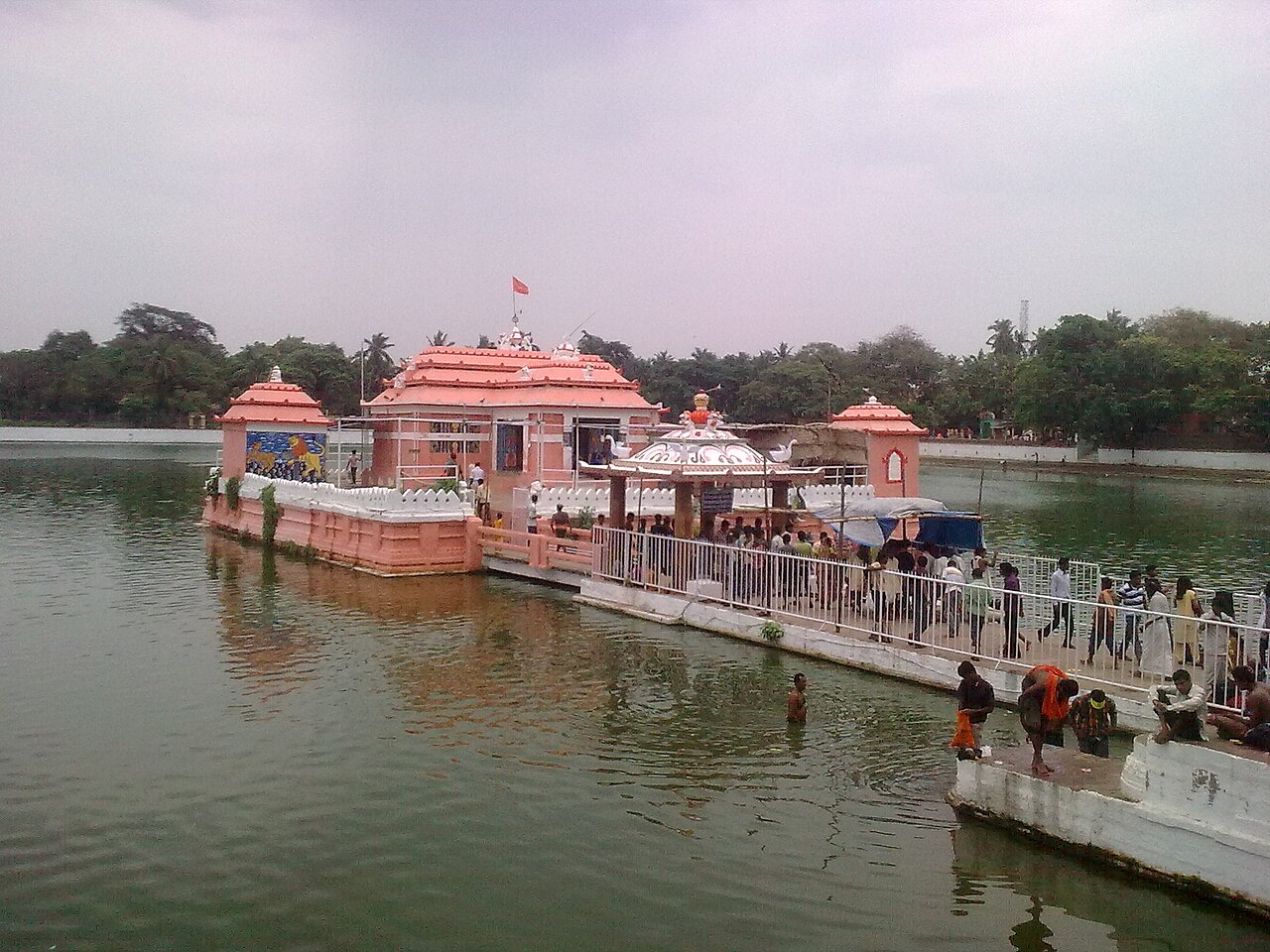
Narendra Tank is a large rectangular water body with stone ghats on all four sides and a small temple island at its centre, functioning for most of the year as a quiet civic landmark in Puri's older quarter and, for three weeks each spring, as the ceremonial stage for Chandan Yatra — one of the Jagannath Temple's most elaborate annual festivals and, by a wide margin, one of the least known to visitors outside Odisha, especially set against the scale and international profile of Rath Yatra.
Best time of day: Evening during Chandan Yatra. For the boat procession; early morning or late afternoon in the rest of the year, for a quiet view of the island temple and its reflection.
Narendra Tank timings
- Opening hours
- No fixed hours
Mon–Sun No fixed hours - Accessible dawn to dusk daily
- Closed on
- Open every day
Good to know: Transforms during Chandan Yatra, a 21-day festival in the Hindu month of Vaishakha (typically April–May), when representative images of the deities are taken out nightly on elaborately decorated boats (chapa) for ceremonial rides around the tank during the festival's first 15 days.
Opening hours compiled from jagannath.nic.in and public records, last updated . They change without notice — confirm before you travel. How we write these guides
Narendra Tank ticket price
| Ticket | Price |
|---|---|
| Indian visitors | Free |
| Foreign visitors | Free |
| Children | Free |
| Camera | Free |
The tank is a public, open sacred space with no entry ticket. The small island temple at its centre maintains a voluntary donation box. Unlike the Jagannath Temple's interior, viewing the tank and its festival processions carries no restriction by faith, since these take place in the open rather than inside a restricted sanctum.
Prices compiled from jagannath.nic.in and public records, last updated . They change without notice — confirm before you travel. How we write these guides
Best time to visit Narendra Tank
- Quiet
- Moderate
06:00–09:00
Morning (non-festival)Best time to go
A quiet civic landmark for most of the year; local residents pass through or pause at the ghats, but the tank sees little dedicated tourist traffic outside Chandan Yatra.
Quiet16:00–18:00
Late afternoon (non-festival)
Calm reflection views of the island temple; a low-key stop for visitors exploring Puri's old town away from Grand Road and the beach.
QuietEvening (Chandan Yatra, first 15 days)
Nightly boat procession
Local crowds gather along the ghats to watch the decorated ceremonial boats carry representative deities around the tank. Considerably less crowded than Rath Yatra, but a genuine local festival atmosphere.
ModerateDaytime (Chandan Yatra period)
Festival daytime
The tank is quieter during the day even within the festival window; the main activity and crowd draw is specifically the nightly boat procession.
Quiet
History of Narendra Tank
Chandan Yatra runs 21 days in total during Vaishakha, the pre-monsoon month (typically April to May) when coastal Odisha's heat is at its most severe. The festival is structured in two phases: the first 15 days, called Bahara Chandan ('outer sandalwood'), are celebrated here at Narendra Tank, where representative Vaishnava deities — most prominently Madanmohan, one of the subsidiary images associated with the Jagannath Temple's ritual complex — are taken out nightly on decorated ceremonial boats, or chapa, often built in the shape of animals such as fish, peacocks, or elephants, and rowed in procession around the tank. The final six days, Bhitara Chandan ('inner sandalwood'), are observed within the temple complex itself.
The ritual's underlying purpose is explicitly seasonal: sandalwood paste, prized in Hindu ritual for its cooling properties, is applied to the deities as a form of ceremonial relief from Vaishakha's extreme heat, a practical concern given the coastal Odisha climate at this time of year. The festival is one of a substantial annual cycle of ceremonies recorded in the Jagannath Temple's traditional chronicle, the Madala Panji, which documents a calendar running to dozens of major and minor observances — a reminder that Rath Yatra, however dominant in outside perception, is one part of a far larger and more continuous ritual life centred on the temple.
Rules & etiquette at Narendra Tank
Because Chandan Yatra's boat processions take place in the open, on public water, rather than inside the temple's restricted sanctum, there is no faith-based restriction on who may observe them from the tank's ghats — a genuine and useful contrast to the temple itself, and one of the more accessible ways for a non-Hindu visitor to witness a significant piece of Puri's living ritual calendar up close.
Outside the festival period, the tank functions as an ordinary public space; visitors should treat the island temple with standard Hindu-temple courtesy if approaching it directly (footwear removed, modest dress) but face no restriction simply observing from the ghats.
Tips for visiting Narendra Tank
- 1
Timing a visit specifically for Chandan Yatra evenings rewards the effort: it is one of Puri's most photogenic festival experiences and, because it remains poorly known outside Odisha relative to Rath Yatra, considerably less crowded — a rare combination in a town where most major religious spectacles now draw significant tourist volume alongside pilgrims.
- 2
Outside the festival window, the tank is a brief stop best combined with nearby Markandeshwar Tank and a walking exploration of Puri's older residential sahis, rather than a destination in its own right.
- 3
Because Chandan Yatra's exact dates follow the Hindu lunar calendar and shift by a few days year to year, and because the nightly boat procession's precise timing can vary, confirming the current schedule locally — through a hotel or a Puri-based guide — is worthwhile for anyone planning a trip specifically around the festival.
How to reach Narendra Tank
We haven't pinned Narendra Tank's exact position yet; the map shows the other places in our Puri guide. Use the address below or the directions link.
Narendra Tank, near Balagandi, Puri – 752001, Odisha, approximately 1.5 km northeast of the Jagannath TempleDirections in Google Maps
From Jagannath Temple (Lion Gate)
₹50–₹801.5 km · 8–20 min
By auto; free on foot
From Puri Railway Station
₹80–₹1203.5 km · 10–12 min
Nearest airport
From Biju Patnaik International Airport, Bhubaneswar (BBI)
approximately 66 km, 1 hour 15 minutes by road
Nearest railway station
From Puri Railway Station
approximately 3.5 km, 10–12 minutes by auto-rickshaw
Narendra Tank FAQs
What is Chandan Yatra and when does it happen?
Chandan Yatra is a 21-day festival in the Hindu month of Vaishakha, typically falling in April or May. Its first 15 days are celebrated at Narendra Tank, where representative deities are taken out nightly on decorated ceremonial boats for a procession around the water, as a ritual cooling with sandalwood paste during the hottest part of the Odisha year.
Can non-Hindus watch the Chandan Yatra boat processions?
Yes. The processions take place on open public water rather than inside a restricted temple sanctum, so there is no faith-based restriction on observing from the tank's ghats — one of the more accessible ways to see a significant Jagannath Temple festival up close without the entry restrictions that apply to the temple itself.
Is Narendra Tank worth visiting outside the festival period?
It is a brief, low-key stop rather than a headline attraction outside Chandan Yatra — worth combining with nearby Markandeshwar Tank and a walk through Puri's older residential lanes, but not a destination that warrants a special trip on its own outside the festival window.
How does Chandan Yatra compare to Rath Yatra in scale?
It is far smaller and considerably less known outside Odisha. Where Rath Yatra draws crowds in the hundreds of thousands to millions and requires advance planning around accommodation and crowd safety, Chandan Yatra's evening processions at Narendra Tank remain a comparatively intimate, local affair.
Compiled with AI assistance from official sources and public records, and published only after the checks in How we write these guides. Nobody from Traveliac has visited this place. Last updated . How we rank and check places