Hadimba Devi Temple
#1of 6 places to visit in ManaliManali, Himachal Pradesh
Also known as Dhungri Temple · Hidimba Devi Temple · Hadimba Temple
Quick answer
Opening hours: 08:00–18:00. Entry is free. Allow 45 min. Best time: Early morning.
Updated · Compiled by Traveliac, AI-assisted · 6 min read
- Opening hours
- 08:00–18:00
- Entry fee
- Free
- Time needed
- 45 min
- Best time of day
- Early morning
- Best months
- Mar – Jun, Sep – Oct
- Address
- Dhungri Van Vihar, Old Manali, Manali, Himachal Pradesh 175131
About Hadimba Devi Temple
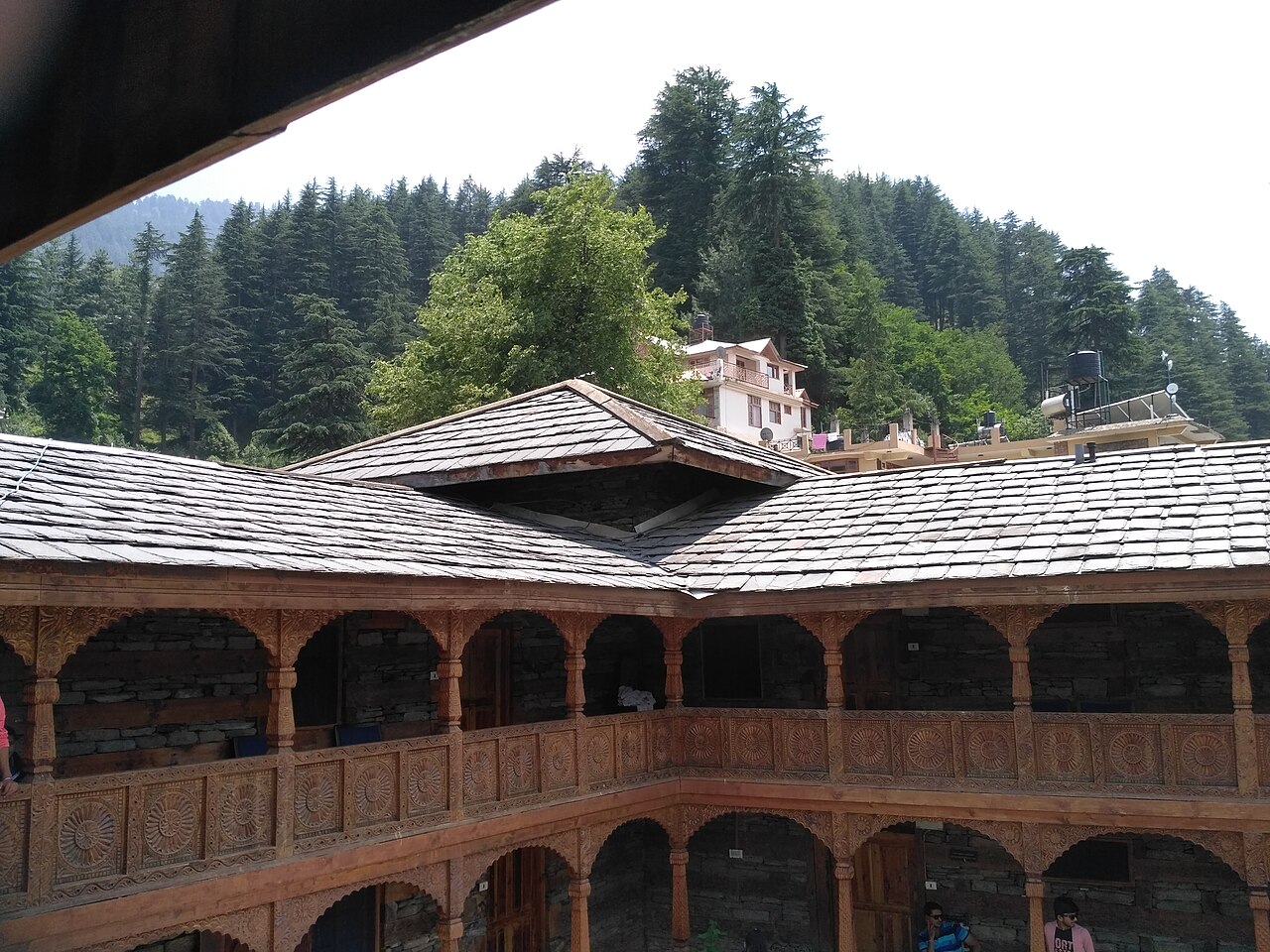
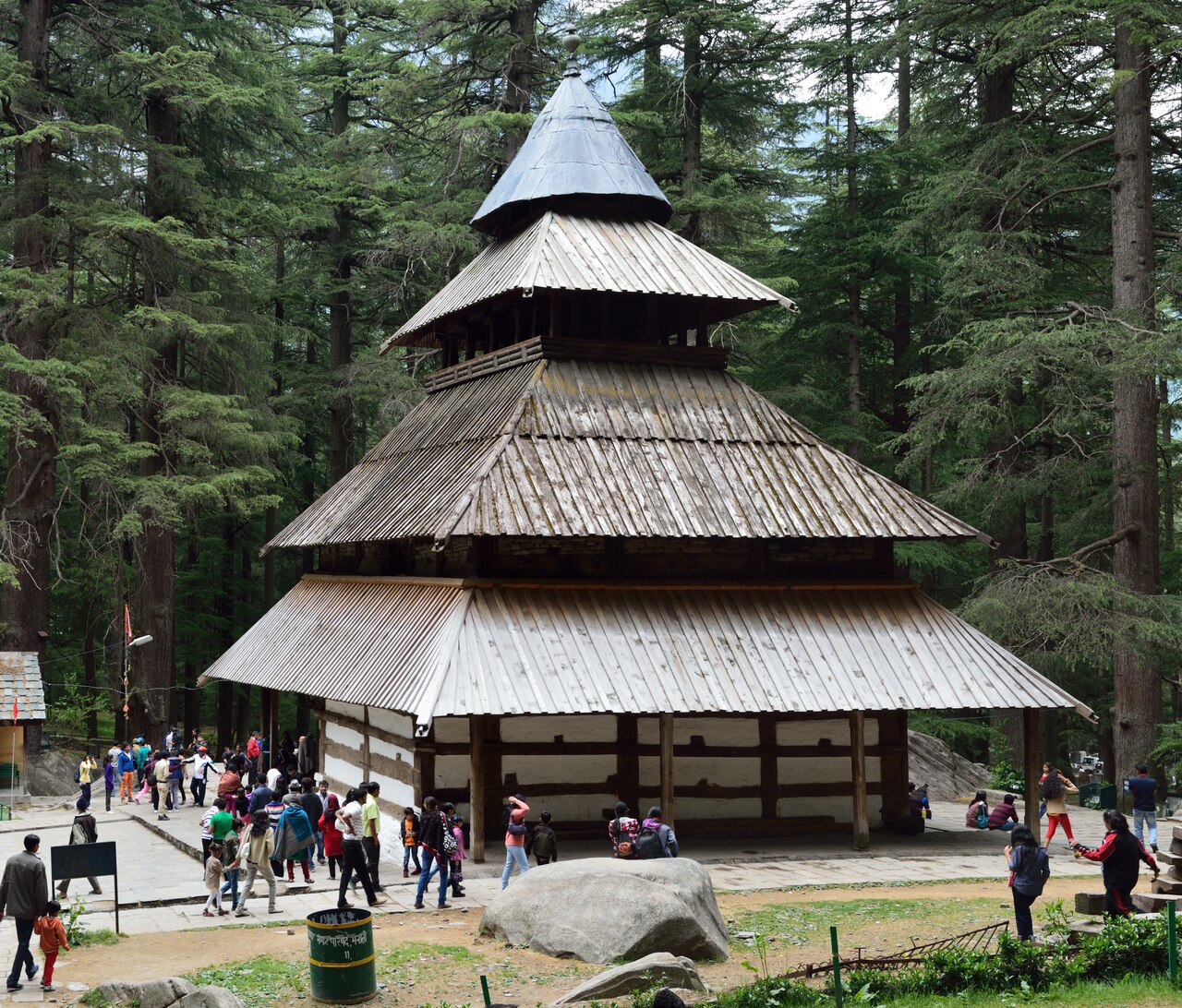
The Hadimba Devi Temple does not announce itself from a distance. The approach is on foot through a grove of deodars — Cedrus deodara — whose trunks measure more than a metre across at chest height, indicating centuries of growth. The pagoda materialises gradually through the canopy: four tiered roofs stacked in diminishing squares, each clad in hand-cut wooden shingles darkened by resin and mountain winters, the uppermost tier crowned with a cluster of brass yak horns and chamri tails that catch the morning light. The structure is 24 metres tall and was built in 1553 without a single nail in the woodwork, relying instead on mortise-and-tenon joinery and the compressive weight of the tiered construction itself. It stands in a clearing of flattened earth surrounded by carved wooden totems and votive bells. The interior is tiny — a single chamber barely large enough for four worshippers at once — centred on a naturally occurring black rock that has been identified as the goddess Hadimba since well before the temple was formalised around it.
Best time of day: Early morning. 07:30–09:00 before tour buses arrive from Manali Mall Road. The deodar grove is at its quietest and light quality is exceptional.
Photography
₹50 camera fee
Hadimba Devi Temple timings
Hadimba Devi Temple opens at 08:00 and closes at 18:00. It keeps the same hours on Saturday and Sunday.
- Opening hours
- 08:00–18:00
Mon–Sun 08:00–18:00 - Closed on
- Open every day
Good to know: The temple remains open year-round including winter, though snow can make the forest path slippery between December and February. During the Hadimba Devi Fair (May–June, exact dates vary by Hindu calendar), access is restricted during formal puja hours.
Opening hours compiled from public records; this place lists no official website, last updated . They change without notice — confirm before you travel. How we write these guides
Hadimba Devi Temple ticket price
| Ticket | Price |
|---|---|
| Indian visitors | Free |
| Foreign visitors | Free |
| Children | Free |
| Camera | ₹50 |
Entry to the temple precincts is free. A fee of ₹50 is charged for photography inside the courtyard. Yak and horse photography or rides near the entrance are priced separately by vendors at ₹100–200; these are commercial operators, not temple fees.
Prices compiled from public records; this place lists no official website, last updated . They change without notice — confirm before you travel. How we write these guides
Best time to visit Hadimba Devi Temple
- Quiet
- Moderate
- Busy
- Very busy
08:00–09:30
Opening windowBest time to go
Primarily local devotees and serious photographers. The forest is quiet and the light enters the deodar canopy from a low eastern angle, casting long shadows across the temple facade.
Quiet09:30–12:00
Morning rush
Tour buses from Mall Road hotels begin arriving. The courtyard fills quickly. Queues for the entrance door form within the hour. Costume rental and yak photography vendors become aggressive.
Busy12:00–14:00
Midday peak
Maximum congestion. The combination of domestic tourists, school groups (in season), and day-trippers from Kullu Valley means the forest path is effectively a pedestrian bottleneck.
Very busy14:00–16:30
Afternoon lull
Crowds thin as visitors return to Manali for lunch and afternoon rest. Manageable but not quiet. Light quality on the western face of the pagoda improves from around 15:30.
Moderate16:30–18:00
Late afternoon
The second-best window. Most tour groups have departed. The forest is cool, the evening puja bell rings around 17:30, and the closing ritual draws a small, attentive crowd of devotees.
Quiet
History of Hadimba Devi Temple
Hadimba, according to the Mahabharata, was the demoness-sister of the rakshasa Hidimba, who was slain by Bhima, the second Pandava brother, when the Pandavas were in exile in the forests. Bhima subsequently married Hadimba, and their union produced Ghatotkacha, a significant warrior in the Kurukshetra war. This narrative places the Dhungri forest as part of the Pandava exile geography, a claim repeated across many sites in Himachal Pradesh and Uttarakhand.
The temple itself was constructed in 1553 CE under the orders of Raja Bahadur Singh of the Kullu dynasty, a member of the Rana family that governed the Kullu Valley for generations. The architect is not named in the temple records, but the construction style — known locally as Kath-Kuni or pagoda-style woodwork — is consistent with Himachali craftmanship of the 15th and 16th centuries found at Parashar Lake Temple and the Bijli Mahadev Temple near Kullu. The three lower roofs are covered in carved wooden panels depicting scenes from the Mahabharata, animals of the Himalayan forest, and geometric patterns. The fourth uppermost roof is clad in metal sheets later.
Hadimba is worshipped as a tutelary deity of the ruling family of Kullu, and historically the Kullu raja would not be seated on his throne without her blessing. The deity's chariot, called a rath, is taken out annually during the Kullu Dussehra festival — one of the largest in Himachal — and processes through Old Manali before joining the main procession. The site was designated a protected monument under the Archaeological Survey of India, which restricts structural alterations while leaving ritual management to the local Devta Samiti (deity council) composed of villagers from Old Manali. The two brass-plated doors of the main entrance were installed in the 17th century and show hunting scenes pressed in relief.
Rules & etiquette at Hadimba Devi Temple
Shoes must be removed at the wooden gate at the bottom of the stone steps, roughly 30 metres before the main entrance. A shoe counter is staffed during temple hours (₹5 per pair deposit, no charge); leaving footwear at the gate post is acceptable but at the visitor's own risk. Leather items — belts, bags, leather-soled footwear — should be left at the shoe counter rather than carried into the courtyard, in keeping with standard temple protocol.
Dress code is moderate: shoulders and knees should be covered, though enforcement is inconsistent during high tourist season. Donated stoles are not available at this temple; carry a dupatta or light shawl. Photography of the main deity icon inside the sanctum is prohibited; the ₹50 camera fee covers courtyard and exterior shots only. Video recording requires a separate ₹100 payment.
The commercial vendors operating yaks and horses in the space immediately around the temple are persistent. A firm, calm refusal works; do not engage in extended negotiation if you have no interest in the service. The Forest Department maintains the Dhungri Van Vihar (woodland picnic area) adjacent to the temple and charges a nominal ₹20 entry for the park area; the temple itself does not fall within the park's fee zone. Guides operating around the temple are unlicensed; the temple priests can provide brief context in Hindi. Do not solicit auto-rickshaw drivers standing near the parking area for guiding services — they are not authorised.
Tips for visiting Hadimba Devi Temple
- 1
The single most important tactical decision is timing. Manali's tourist buses begin arriving from the Mall Road hotels from 09:30 onwards, and by 11:00 the deodar grove is operating at full tourist density — selfie sticks, rented costumes, and queues for the entrance. Arriving at opening time (08:00) means you will share the forest with perhaps a dozen morning devotees and the resident langur monkeys. The walk from Old Manali village takes 15 minutes uphill on a flagstone path; from Mall Road, an auto-rickshaw costs ₹80–120 depending on your bargaining.
- 2
The forest around the temple, designated Dhungri Van Vihar, is worth spending time in separately from the temple visit. The deodar canopy is genuinely ancient and the understory includes rhododendron and wild rose. A 2km loop trail runs through the forest and reconnects with the Manali road near Club House Road — useful for walking back to the centre of town.
- 3
Apple season (late August to October) means vendors at the forest edge sell fresh apples directly from the orchards behind Old Manali at ₹40–60 per kg. Buy here rather than the bazaar. In winter, the stone path to the temple ices over and closed shoes or light crampons are advisable.
How to reach Hadimba Devi Temple
The red star is Hadimba Devi Temple; the numbered pins are the 1 nearest places in our guides, each showing its rank in its city. Tap a pin for details.
Dhungri Van Vihar, Old Manali, Manali, Himachal Pradesh 175131Directions in Google Maps
From Manali Mall Road
₹80–1202.5 km · 10 min
Negotiate before boarding; the ₹120 ceiling is for tourists without local knowledge
From Old Manali Village
0.8 km · 15 min
Free — flagstone path from Old Manali bridge
From Bhuntar Airport (Kullu-Manali Airport)
₹1,200–1,80050 km · 90 min
HRTC prepaid taxi counter at airport; avoid touts outside arrival exit
From Manali Bus Stand (HRTC)
₹100–1503 km · 12 min
Nearest airport
From Bhuntar Airport (Kullu-Manali Airport), 50km south
Nearest railway station
From Joginder Nagar Narrow Gauge Railway Station, 165km; Chandigarh Junction, 310km
Hadimba Devi Temple FAQs
Is the Hadimba Temple open during snowfall in December and January?
Yes, the temple remains open year-round. However, the path from Old Manali can be icy and slippery in heavy snowfall. The temple itself is heated by a small brazier kept lit by the priests during winter puja hours. Expect far smaller crowds and a more austere atmosphere.
Are non-Hindus allowed inside the temple sanctum?
Yes. The temple does not restrict entry by religion. Non-Hindu visitors are welcomed into the main chamber but should observe the same courtesy as at any active place of worship — remove shoes, keep voices low, do not photograph the main deity icon, and step aside during active puja.
How do the yak and horse rental vendors near the temple work?
These are entirely commercial operators with no affiliation to the temple or the Forest Department. They rent local dress (Kullu-pattern shawls and caps) and photograph visitors with yaks or on horseback, typically charging ₹100–200 per session. They can be persistent. You are under no obligation and polite but firm refusal is effective. Do not hand your phone to any vendor for photography before agreeing on a price.
What is the Hadimba Devi Fair and when does it occur?
The Hadimba Devi Fair is an annual festival held in May–June (exact dates follow the Hindu lunar calendar) in the grounds surrounding the temple. The three-day event includes ritual processions, folk music, dance performances, and market stalls selling Kullui crafts. Local visitors far outnumber tourists; it is one of the most genuinely local celebrations accessible to visitors in Manali.
Compiled with AI assistance from official sources and public records, and published only after the checks in How we write these guides. Nobody from Traveliac has visited this place. Last updated . How we rank and check places
Places to visit near Hadimba Devi Temple
Straight-line distances from our map; times are estimates.