Jogini Waterfall
#4of 6 places to visit in ManaliManali, Himachal Pradesh
Also known as Jogini Falls · Jogini Devi Waterfall
Quick answer
Opening hours: 07:00–17:00. Entry is free. Allow 2.5 hrs. Best time: 08:00–10:30.
Updated · Compiled by Traveliac, AI-assisted · 4 min read
- Opening hours
- 07:00–17:00
- Trail accessible daylight hours only, effectively 07:00–17:00. No gate or formal opening time.
- Entry fee
- Free
- Time needed
- 2.5 hrs
- Best time of day
- 08:00–10:30
- Best months
- Mar – Jun, Sep – Oct
- Address
- Trailhead at upper Vashisht Village, 3km northeast of Manali Mall Road, Himachal Pradesh 175103
About Jogini Waterfall
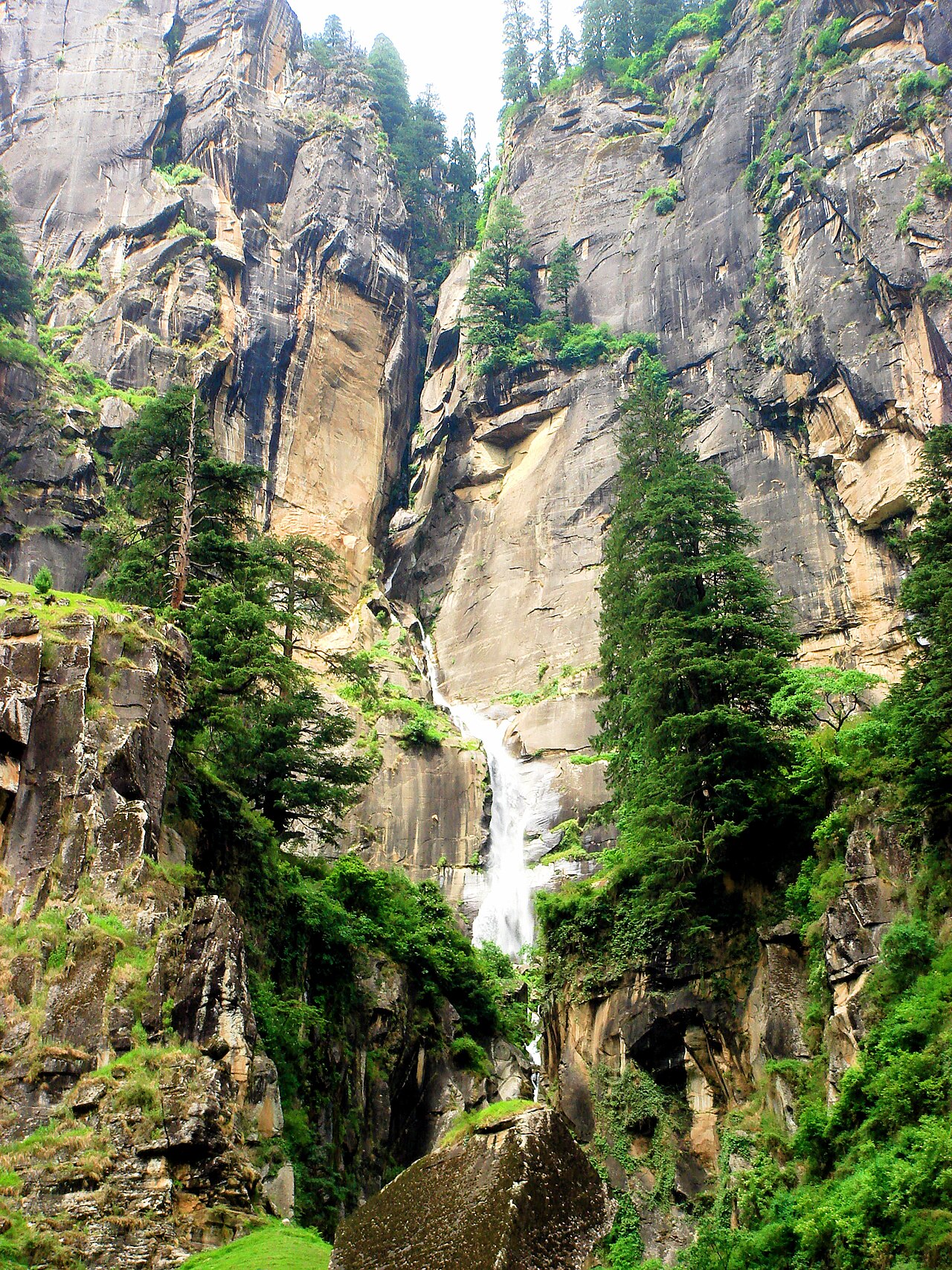
Jogini Waterfall drops roughly 45 metres down a granite face above Vashisht village, reached by a trail that climbs through mixed deodar and pine forest for about 3 kilometres from the upper edge of the village. The walk itself is more the point than the falls: the path switchbacks past small stone-walled orchard terraces, crosses two footbridges over the Jogini stream, and opens periodically onto clear views back down the Beas valley toward Manali and, on good days, the ridgeline above Solang. The falls are named for the Jogini Devi, a local mountain goddess with a small shrine near the base, and the pool beneath the main drop is popular for wading, though the current and submerged rocks make full immersion inadvisable beyond the shallows.
Best time of day: 08:00–10:30. To complete the climb before the afternoon sun heats the exposed rock sections near the falls and before the trail's midday crowd builds.
Jogini Waterfall timings
Jogini Waterfall opens at 07:00 and closes at 17:00. It keeps the same hours on Saturday and Sunday.
- Opening hours
- 07:00–17:00
Mon–Sun 07:00–17:00 - Trail accessible daylight hours only, effectively 07:00–17:00. No gate or formal opening time.
- Closed on
- Open every day
Good to know: Best walked March–June and September–November. Monsoon months (July–August) bring a landslide and slippery-rock risk on the exposed sections near the falls, and the trail can be dangerous after heavy rain. Snow closes the upper trail intermittently December–February, though the lower stretch through Vashisht remains walkable.
Opening hours compiled from hptdc.com and public records, last updated . They change without notice — confirm before you travel. How we write these guides
Jogini Waterfall ticket price
| Ticket | Price |
|---|---|
| Indian visitors | Free |
| Foreign visitors | Free |
| Children | Free |
| Camera | Free |
No entry fee for the trail or the waterfall. Informal chai stalls along the path charge normal small-vendor prices (₹20–50 per cup/snack). No official ticket counter or forest department checkpoint exists on this route.
Prices compiled from hptdc.com and public records, last updated . They change without notice — confirm before you travel. How we write these guides
Best time to visit Jogini Waterfall
- Quiet
- Moderate
- Busy
07:00–09:00
Early climbersBest time to go
Mostly serious walkers and photographers. The forest is at its quietest and the light through the deodar canopy is best for photography.
Quiet09:00–12:00
Main tourist wave
Day-trip visitors from Manali arrive via Vashisht in volume. The final rock scramble near the falls becomes congested and cautious footing is more important with more people on the wet rock.
Busy12:00–15:00
Midday
Crowd thins somewhat as the day's heat builds and earlier arrivals head back down. Chai stalls do steady trade.
Moderate15:00–17:00
Late afternoon descent
Most visitors are already descending. Late starters should budget carefully to be off the trail before dusk, since there is no lighting.
Quiet
History of Jogini Waterfall
Jogini has no dated monument or documented founding — its significance is entirely as a local sacred-landscape feature, one of many sites across the Kullu Valley where a waterfall, spring, or unusual rock formation has been associated with a devi or local deity and folded into the region's dense network of village-level worship. The Jogini Devi shrine at the base of the falls is maintained by Vashisht village rather than any formal temple trust, and pilgrimage to it remains largely a local practice rather than a pan-Indian one.
The trail's popularity with international and domestic tourists is a recent, tourism-driven development, dating to Manali's broader expansion as a trekking base from the 1980s onward. What was previously a village path used for grazing access and firewood collection has become one of the most-walked short treks out of Manali precisely because it requires no permit, no vehicle beyond reaching Vashisht, and delivers a genuine waterfall and forest walk within half a day.
Rules & etiquette at Jogini Waterfall
There is no ticketing, gate, or forest department checkpoint on this trail, which also means there is no formal safety infrastructure — no railings at the exposed sections near the top of the falls, no marked emergency contact point, and no ranger patrol. Visitors have been injured, in a small number of cases fatally, from slipping on wet rock while attempting to get closer to the falls or pose for photographs at the edge of the drop; treat the rock immediately around the waterfall as unsecured terrain regardless of how many other visitors are standing on it.
The Jogini Devi shrine at the base expects the same modest courtesy as any village shrine — no swimming or loud behaviour in its immediate vicinity, appropriate dress if entering the small structure itself.
Litter has become a visible problem on this route given the volume of tourist foot traffic; carry out what you carry in, since there are no waste bins along the trail.
Tips for visiting Jogini Waterfall
- 1
Footwear matters more here than the trail's short length suggests: the path is unpaved dirt and loose stone for most of its length, with a genuinely slick, water-smoothed rock scramble in the final 100 metres before the falls. Trainers with reasonable tread are adequate in dry conditions; flip-flops, worn by a surprising number of visitors, are a common cause of minor falls.
- 2
The round trip from the Vashisht trailhead takes 2–2.5 hours at an unhurried pace including time at the falls, making this comfortably combinable with a hot-spring soak at Vashisht either before or after. Starting the walk by 08:00 avoids both the heat of a midday climb and the crowd that builds from around 10:30 once day-trip taxis from Manali have dropped visitors at Vashisht.
- 3
Several small chai and Maggi noodle stalls operate along the route in season, run by Vashisht residents; they are a reasonable rest stop roughly two-thirds of the way up and close by early evening. There is no need to carry much water for the walk itself, but bring enough for a hot day, since none is sold above the mid-point stalls.
How to reach Jogini Waterfall
We haven't pinned Jogini Waterfall's exact position yet; the map shows the other places in our Manali guide. Use the address below or the directions link.
Trailhead at upper Vashisht Village, 3km northeast of Manali Mall Road, Himachal Pradesh 175103Directions in Google Maps
From Vashisht Village (temple/hot springs)
0.3 km · 5 min
Free
From Manali Mall Road
₹80–1203 km · 15 min
To Vashisht trailhead
From Bhuntar Airport (Kullu-Manali Airport)
₹1,300–1,90055 km · 100 min
To Vashisht
Nearest airport
From Bhuntar Airport (Kullu-Manali Airport), 55km south
Nearest railway station
From Joginder Nagar Narrow Gauge Railway Station, 170km; Chandigarh Junction, 315km
Jogini Waterfall FAQs
How long does the Jogini Waterfall trek take?
Roughly 2 to 2.5 hours round trip from the Vashisht trailhead at an unhurried pace, including time spent at the falls. The climb is about 3 kilometres one way and gains a moderate amount of elevation through forest and orchard terraces.
Is the Jogini Waterfall trek difficult or suitable for beginners?
The trail itself is a moderate, non-technical uphill walk manageable by most reasonably fit visitors, children included. The genuine hazard is the final approach to the falls, where wet, unrailed rock has caused falls and, rarely, fatalities among visitors trying to get close to the edge for photographs.
Can you swim at Jogini Waterfall?
Wading in the shallow pool below the main drop is common, but the current and submerged rocks make full immersion or swimming near the base of the falls genuinely risky. Stay in the clearly shallow margins and avoid the area directly under the falling water.
Is a guide necessary for the Jogini trek?
No. The path is a single, well-worn trail with no forks serious enough to cause navigation problems, and no permit or forest department registration is required. A guide adds context but is not necessary for safe navigation in daylight.
Compiled with AI assistance from official sources and public records, and published only after the checks in How we write these guides. Nobody from Traveliac has visited this place. Last updated . How we rank and check places