Jogyesa Temple
#5of 10 places to visit in SeoulSeoul, Seoul Capital Area, South Korea
Also known as Jogye Temple · 조계사 · Jogye Order Head Temple
Quick answer
Opening hours: No fixed opening hours. Entry is free. Allow 45 min. Best time: 07:30-09:00.
Updated · Compiled by Traveliac, AI-assisted · 4 min read
- Opening hours
- No fixed hours
- The grounds are open daily. The Daeungjeon main hall is generally open from early morning until about 21:00, but exact hours are not published in a source this guide could verify, so check at the gate or on the temple's own website.
- Entry fee
- Free
- Time needed
- 45 min
- Best time of day
- 07:30-09:00
- Best months
- Apr – Jun, Sep – Oct
- Address
- 55 Ujeongguk-ro, Jongno-gu, Seoul 03145, South Korea
About Jogyesa Temple
Jogyesa Temple is free to enter, as of 2026, and is the head temple of the Jogye Order, the largest school of Korean Buddhism. Korean tourism sources date the temple to 1395, when it was first named Gakhwangsa, though the present complex is early twentieth-century, and the current name dates from 1954. Daeungjeon, the main hall, is a timber building whose roof is held up by pine brought from Mount Baekdu, painted in dancheong pigment. Two trees in the courtyard, a white pine about 500 years old (Natural Monument No. 9) and a 26-metre Chinese scholar tree, shade the courtyard.
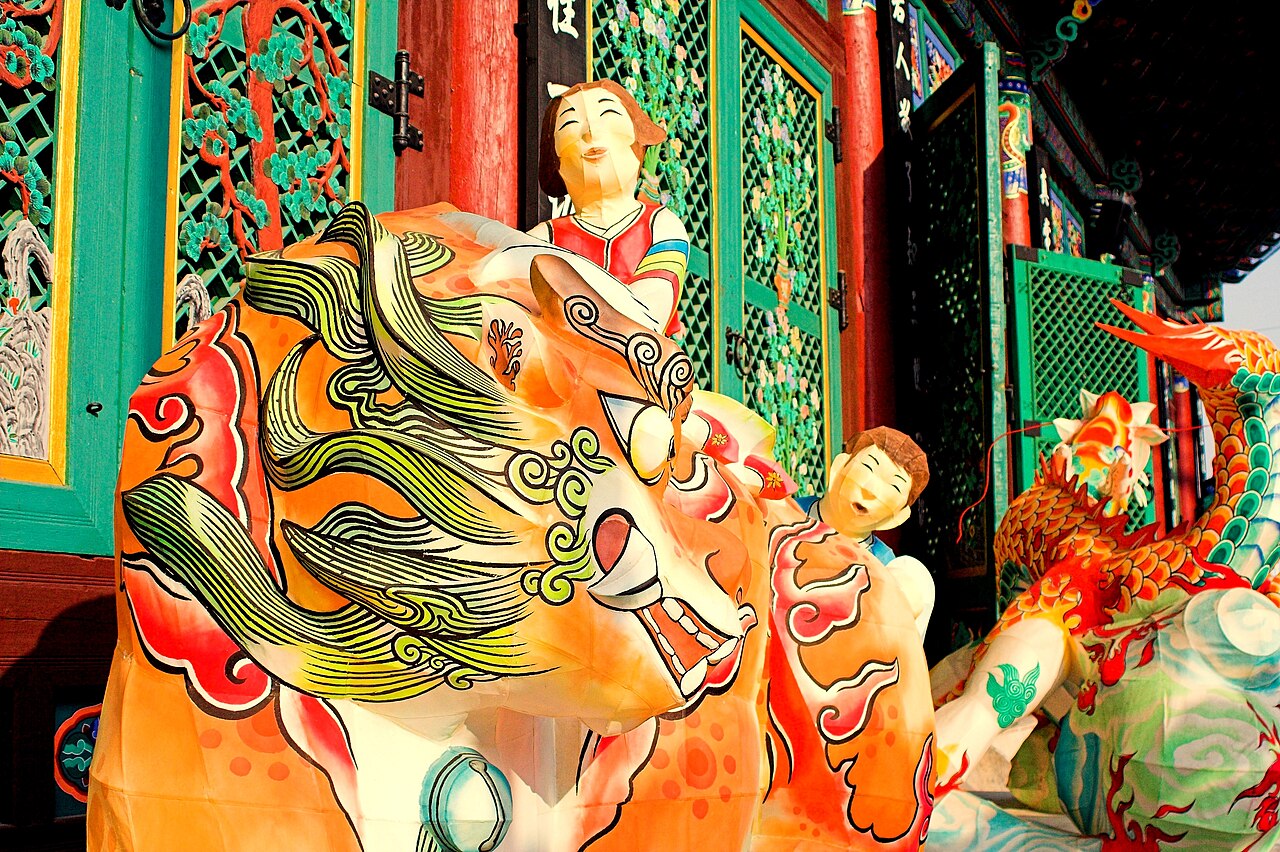
Best time of day: 07:30-09:00. For morning chanting and empty courtyards; late April to mid-May for the lantern displays, which are lit after dark.
Jogyesa Temple timings
- Opening hours
- No fixed hours
Mon–Sun No fixed hours - The grounds are open daily. The Daeungjeon main hall is generally open from early morning until about 21:00, but exact hours are not published in a source this guide could verify, so check at the gate or on the temple's own website.
- Closed on
- Open every day
Good to know: Buddha's Birthday (a public holiday in May, 24 May in 2026) fills the courtyard with lanterns, and the grounds are decorated for several weeks beforehand. The Lotus Lantern Festival parade runs along Jongno on the preceding weekend.
Opening hours compiled from jogyesa.kr and public records, last updated . They change without notice — confirm before you travel. How we write these guides
Jogyesa Temple ticket price
| Ticket | Price |
|---|---|
| Standard ticket | Free |
| Concession (student / senior) | Free |
| Children | Free |
Jogyesa Temple has no admission fee, as of 2026. Donations are optional. Templestay programmes, meditation classes and temple-food meals run through the Templestay information centre and are priced separately; verify current prices and booking rules on the Templestay site.
Prices compiled from jogyesa.kr and public records, last updated . They change without notice — confirm before you travel. How we write these guides
Best time to visit Jogyesa Temple
- Quiet
- Moderate
- Busy
06:00 - 09:00
Morning ChantingBest time to go
Worshippers and a few early visitors; chanting in Daeungjeon and a quiet courtyard set the best atmosphere of the day.
Quiet09:00 - 12:00
Tour Group Window
Guided groups from Insadong and Bukchon pass through; the courtyard is busy but the main hall remains manageable.
Moderate12:00 - 17:00
Afternoon Wander
Visitors on Insadong walking routes arrive steadily; on weekends and in May the lantern displays draw dense crowds.
Busy17:00 - 21:00
Evening Calm
Crowds thin after dinner-time, and in lantern season the illuminated courtyard gives the best photographs.
Quiet
History of Jogyesa Temple
Jogyesa Temple traces its origins to Gakhwangsa, which the Korea Tourism Organization dates to 1395. The Joseon court favoured Confucianism and kept monks out of the capital for centuries, so treat 1395 as an institutional claim rather than an unbroken history; the buildings visitors see belong to the early twentieth century, when Korean Buddhism re-established a headquarters inside Seoul.
Jogyesa Temple became the chief temple of the Jogye Order in 1936, and Daeungjeon, the main hall, was constructed in 1938. The Jogye Order describes a lineage stretching back some 1,700 years, combining Korean Zen (Seon) and textual schools. Today the temple hosts daily chanting, monastic rituals, the annual Lotus Lantern Festival (Important Intangible Cultural Property No. 122) and Templestay programmes for foreign visitors.
Rules & etiquette at Jogyesa Temple
Jogyesa Temple is a working place of worship, and visitors take off their shoes before entering the Daeungjeon main hall and keep them off during services. Modest dress is expected: covered shoulders and knees are the safe choice, and hats are removed inside. Photographs of the main hall are usually tolerated, but flash and photographing worshippers at close range are not.
Jogyesa Temple asks visitors to keep their voices low, not to point their feet toward the Buddha statue, and not to touch the offerings or altar. Joining palms at the chest (hapjang) and a light bow is the accepted greeting to monks and images. Donations go into the box at the hall entrance; do not press money into the hands of monks or volunteers.
Tips for visiting Jogyesa Temple
- 1
Jogyesa Temple sits between Insadong and Bukchon, so use it as a pause rather than a full stop: 30 to 45 minutes is enough for the courtyard trees, the main hall and the small Buddhist bookshops and tea rooms on the perimeter. Visit at 09:00 or after 17:00 to avoid tour groups that arrive mid-morning.
- 2
Jogyesa Temple is at its most striking in late April and early May, when thousands of paper lanterns hang across the courtyard for Buddha's Birthday, and the fully lit compound after dusk is a free evening stop. During the Lotus Lantern Festival, Jongno is closed to traffic and the temple becomes very crowded; arrive before mid-afternoon or plan around the parade. For a longer experience, the Templestay information centre beside the temple can arrange one-day cultural programmes such as lantern-making and tea meditation, with English options; verify the programme list and prices directly.
How to reach Jogyesa Temple
We haven't pinned Jogyesa Temple's exact position yet; the map shows the other places in our Seoul guide. Use the address below or the directions link.
55 Ujeongguk-ro, Jongno-gu, Seoul 03145, South KoreaDirections in Google Maps
From Incheon International Airport (ICN)
60 km · 80-95 min
KRW 4,750-5,000 all-stop AREX plus KRW 1,550-1,650 subway (as of 2026, verify)
From Seoul Station
3 km · 8-12 min plus 7 min walk
KRW 1,550-1,650 with a T-money card (as of 2026, verify)
From Gyeongbokgung Palace
1.5 km · 20 min on foot
Free on foot, or KRW 1,550-1,650 by subway
Nearest airport
From Incheon International Airport (ICN)
about 60 km, 45 minutes by AREX express to Seoul Station plus 20 minutes by subway.
Nearest station
From Anguk Station (Line 3), Exit 6, or Jonggak Station (Line 1), Exit 2, each roughly 5-8 minutes' walk.
Jogyesa Temple FAQs
Is Jogyesa Temple free to enter?
Yes. Jogyesa Temple has no admission fee, as of 2026, though donations are welcome and Templestay or class programmes are priced separately.
Can visitors go inside the main hall at Jogyesa Temple?
Yes. Visitors may enter Daeungjeon during opening hours if they remove their shoes, dress modestly and stay quiet; avoid flash and photographing worshippers.
What is Jogyesa Temple known for?
Jogyesa Temple is the head temple of the Jogye Order, the largest school of Korean Buddhism. It is also the centre of the Lotus Lantern Festival for Buddha's Birthday.
When are the lanterns at Jogyesa Temple lit?
The lanterns hang for several weeks before Buddha's Birthday, which falls on 24 May in 2026. The courtyard is lit after dusk, and the parade runs along Jongno on the weekend before the holiday.
Compiled with AI assistance from official sources and public records, and published only after the checks in How we write these guides. Nobody from Traveliac has visited this place. Last updated . How we rank and check places