Jama Masjid, Agra
#3of 9 places to visit in AgraAgra, Uttar Pradesh
Also known as Agra Jama Masjid
Quick answer
Opening hours: 07:00–12:00 and 13:30–18:30. Entry is free. Allow 45 min. Best time: Late afternoon.
Updated · Compiled by Traveliac, AI-assisted · 4 min read
- Opening hours
- 07:00–18:30
- 07:00 – 12:00 and 13:30 – 18:30 daily, closed to non-worshippers during the five daily prayer times.
- Entry fee
- Free
- Time needed
- 45 min
- Best time of day
- Late afternoon
- Best months
- Oct – Mar
- Address
- Kinari Bazaar, opposite Agra Fort Railway Station, Agra, Uttar Pradesh 282003
About Jama Masjid, Agra
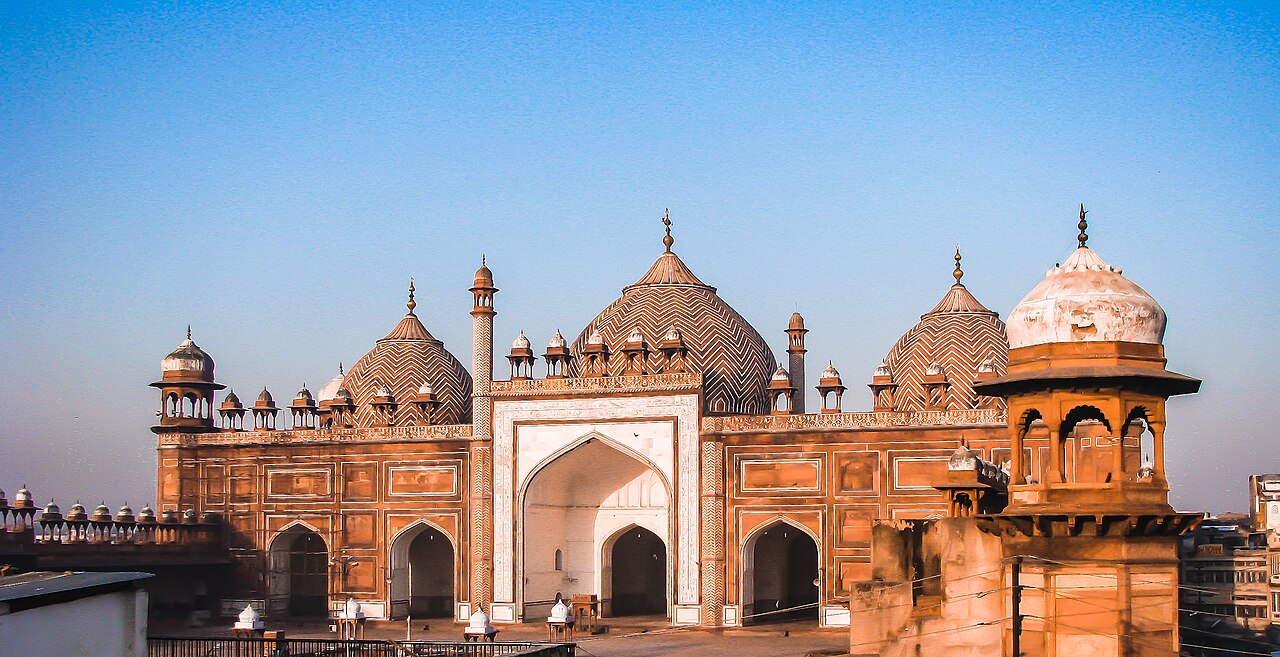
Jama Masjid charges no entry fee, though the mosque committee levies a ₹30 charge for still photography as of 2026. Jahanara Begum, Shah Jahan's eldest daughter and one of the wealthiest women in the Mughal empire in her own right, commissioned the mosque in 1643, and construction took roughly five years to complete in 1648 using an estimated five thousand labourers and craftsmen. The mosque stands directly opposite Agra Fort Railway Station in the old city's Kinari Bazaar quarter, its red sandstone and marble façade rising over a market district so dense that the building's full scale is only apparent from directly in front of its eastern steps.
Best time of day: Late afternoon. Roughly an hour before sunset, when local worshippers arrive for prayer and the mosque is at its most active.
Jama Masjid, Agra timings
Jama Masjid, Agra is open 07:00–12:00 and 13:30–18:30. The weekend is no different: Saturday and Sunday follow the same times.
- Opening hours
- 07:00–18:30
Mon–Sun 07:00–12:00 and 13:30–18:30 - 07:00 – 12:00 and 13:30 – 18:30 daily, closed to non-worshippers during the five daily prayer times.
- Closed on
- Open every day
Good to know: Friday midday prayers draw large congregations; a tourist visit during that window is impractical.
Opening hours compiled from uptourism.gov.in and public records, last updated . They change without notice — confirm before you travel. How we write these guides
Jama Masjid, Agra ticket price
| Ticket | Price |
|---|---|
| Indian visitors | Free |
| Foreign visitors | Free |
| Children | Free |
| Camera | Free |
No entry fee for any nationality. The mosque committee charges ₹30 for still photography as of 2026; verify at the entrance as this is set locally rather than by the ASI.
Prices compiled from uptourism.gov.in and public records, last updated . They change without notice — confirm before you travel. How we write these guides
Best time to visit Jama Masjid, Agra
- Quiet
- Moderate
07:00 – 10:00
Morning OpeningBest time to go
The courtyard is quiet outside prayer times. Kinari Bazaar around the mosque is just beginning its trading day.
Quiet10:00 – 13:30
Midday / Prayer Closure
The mosque closes to non-worshippers during midday prayer times; Friday sees a large congregation that makes a tourist visit impractical.
Moderate13:30 – 17:00
Afternoon
A small, steady trickle of visitors and worshippers. Kinari Bazaar is at its busiest trading period around the mosque's base.
Quiet17:00 – 18:30
Evening Prayer
Local worshippers arrive ahead of evening prayer, giving the clearest sense of the mosque's active community function before closing.
Moderate
History of Jama Masjid, Agra
Jama Masjid's patron, Jahanara Begum, held the unusual title of Padshah Begum, or First Lady of the Empire, after her mother Mumtaz Mahal's death in 1631, and she used her considerable personal wealth from trade revenues and royal grants to fund several major religious buildings across the empire, of which this Agra mosque is among the largest. The mosque's design uses alternating bands of red sandstone and white marble across three bulbous domes, a striping technique distinct from the plain marble domes of the Taj Mahal built by her father in the same decade, and Persian-style calligraphic inscriptions run across the entrance archway crediting Jahanara by name, a rare instance of a Mughal royal woman receiving explicit architectural credit on a public building. The mosque originally faced a large courtyard and market area connecting directly to Agra Fort, a layout later disrupted when the British colonial administration built the railway line and Agra Fort Railway Station through the intervening space in the 1850s, permanently severing the mosque's visual relationship with the fort it once fronted.
Rules & etiquette at Jama Masjid, Agra
Jama Masjid functions as an active place of worship, and visitors of any faith may enter outside of prayer times, but modest dress covering shoulders and knees is expected, and women may be asked to cover their heads at the discretion of mosque staff. Shoes must be removed before stepping onto the courtyard's stone paving, with a free shoe-deposit area near the main eastern steps. The mosque closes to non-worshippers during the five daily prayer times, and Friday midday prayers draw large congregations that make a tourist visit impractical during that window. Still photography requires the ₹30 fee paid to mosque staff on entry; video recording is generally discouraged inside the prayer hall itself.
Tips for visiting Jama Masjid, Agra
- 1
Jama Masjid sits within a two-minute walk of Agra Fort Railway Station, making it one of the easiest monuments in Agra to combine with a same-day visit to Agra Fort itself, roughly 1 kilometre further south. The surrounding Kinari Bazaar is one of Agra's oldest and densest wholesale markets, trading in textiles, wedding decorations, and metalware, and a walk through its narrow lanes before or after the mosque gives a far more textured sense of the old city than the monument circuit alone. Late afternoon, roughly an hour before sunset, brings the call to prayer and a steady flow of local worshippers, a more authentic view of the mosque's continuing function than a purely tourist-timed visit. Because the mosque charges no admission and receives a fraction of the Taj Mahal's footfall, it works well as a low-key final stop after a morning spent at the more crowded ticketed sites.
How to reach Jama Masjid, Agra
The red star is Jama Masjid, Agra; the numbered pins are the 7 nearest places in our guides, each showing its rank in its city. Tap a pin for details.
Kinari Bazaar, opposite Agra Fort Railway Station, Agra, Uttar Pradesh 282003Directions in Google Maps
From Agra Fort Railway Station (AF)
0.3 km · under 5 min
Walkable
From Agra Cantonment Railway Station (AGC)
₹120–1805 km · 15–20 min
Auto, negotiated
Nearest airport
From Agra Airport (AGR, Kheria)
9 km, 20–30 minutes by road.
Nearest railway station
From Agra Fort Railway Station (AF)
directly opposite the mosque, under 5 minutes on foot.
Jama Masjid, Agra FAQs
Is there an entry fee for Jama Masjid in Agra?
No. Entry is free for all visitors. The mosque committee charges a separate ₹30 fee for still photography as of 2026, collected on entry.
Who built the Jama Masjid in Agra?
Jahanara Begum, Shah Jahan's eldest daughter, commissioned the mosque in 1643. Construction took about five years, finishing in 1648, making it a rare Mughal monument credited explicitly to a royal woman.
Can non-Muslim visitors enter Jama Masjid Agra?
Yes. Visitors of any faith may enter outside prayer times, provided they dress modestly and remove their shoes at the courtyard entrance. Entry is closed to non-worshippers during the five daily prayer times.
How close is Jama Masjid to Agra Fort?
It sits about 1 kilometre north of Agra Fort and directly opposite Agra Fort Railway Station, making the two an easy same-day, walkable-adjacent pairing.
Compiled with AI assistance from official sources and public records, and published only after the checks in How we write these guides. Nobody from Traveliac has visited this place. Last updated . How we rank and check places
Places to visit near Jama Masjid, Agra
Straight-line distances from our map; times are estimates.