Akshardham Temple
#7of 9 places to visit in New DelhiNew Delhi, Delhi
Also known as Swaminarayan Akshardham · Delhi Akshardham
Quick answer
Opening hours: 09:30–18:30, closed Mondays, last entry 18:00. Entry is free. Allow 3.5 hrs. Best time: 09:30 – 11:30.
Updated · Compiled by Traveliac, AI-assisted · 5 min read
- Opening hours
- 09:30–18:30
- Closed Mondays
- Entry fee
- Free
- Time needed
- 3.5 hrs
- Best time of day
- 09:30 – 11:30
- Best months
- Oct – Nov, Feb – Mar
- Address
- Noida Mor, near Noida Link Road, New Delhi, Delhi 110092
About Akshardham Temple
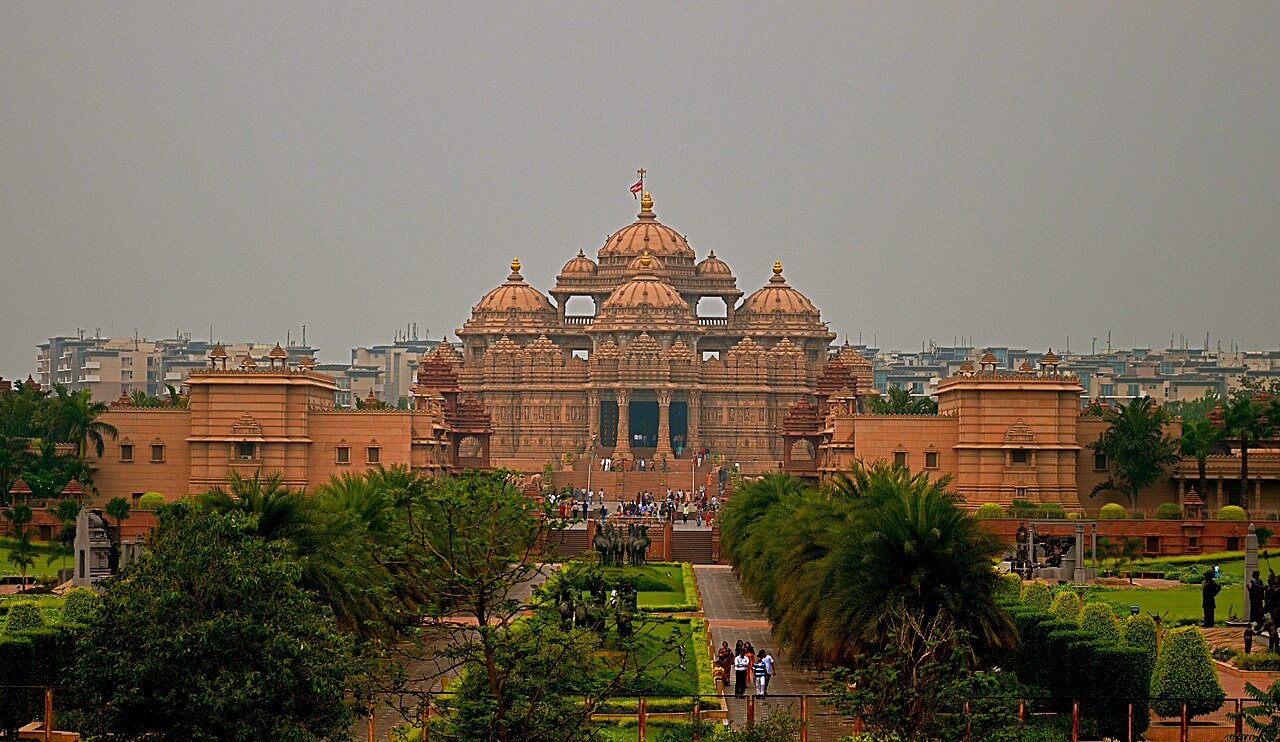
Swaminarayan Akshardham occupies 100 acres on the eastern bank of the Yamuna and was completed in 2005, built entirely without structural steel — every load-bearing element is carved stone, following construction methods drawn from the ancient Shilpa Shastra texts on temple architecture. The central monument stands 43 metres tall and is faced in pink sandstone and white Carrara marble, carved by a workforce the BAPS Swaminarayan Sanstha reports at roughly 7,000 artisans and volunteers, producing 234 ornately carved pillars, nine domes, and some 20,000 individual murtis and figures across the structure. Guinness World Records recognised the complex in 2007 as the largest comprehensive Hindu temple in the world by measured criteria. The temple's central sanctum houses a 3.4-metre gold-leafed murti of Bhagwan Swaminarayan, the 18th–19th century founder of the Swaminarayan sect of Hinduism, flanked by murtis of his principal disciples and gurus in the BAPS lineage. Beyond the monument itself, the complex functions as a self-contained cultural park: a stepped Yagnapurush Kund water feature claimed as the world's largest stepwell of its kind, extensive Bharat Upavan gardens with bronze sculptures of historical and mythological Indian figures, and three separate ticketed exhibitions covering Swaminarayan's life and broader Indian civilisational history through animatronics, boat rides, and an IMAX-style film.
Best time of day: 09:30 – 11:30. For the temple monument itself, before tour groups peak; evening (after 18:00, where schedules allow) for the illuminated exhibitions and Water Show, which are a distinct experience from the daytime visit.
Akshardham Temple timings
Akshardham Temple opens at 09:30 and closes at 18:30. Those hours hold on Saturday and Sunday too.
- Opening hours
- 09:30–18:30
Monday Closed Tue–Sun 09:30–18:30 - Temple monument and gardens: 09:30 – 18:30 (Tuesday–Sunday, last entry 18:00); exhibitions run on a separate schedule until approximately 20:00; the Water Show has fixed evening showtimes.
- Closed on
- Monday
Opening hours compiled from akshardham.com and public records, last updated . They change without notice — confirm before you travel. How we write these guides
Akshardham Temple ticket price
| Ticket | Price |
|---|---|
| Indian visitors | Free |
| Foreign visitors | Free |
| Children | Free |
| Camera | Free |
Entry to the main temple monument and gardens is free. The three paid exhibitions inside the complex — the Sahaj Anand Water Show, the Sanskruti Vihar boat ride, and the Neelkanth Darshan large-format film — are ticketed separately or as a combined pass, typically ₹170–₹575 depending on which are included. Electronics are not permitted inside at any price tier; locker charges for phones, cameras, and bags are separate from the exhibition tickets.
Prices compiled from akshardham.com and public records, last updated . They change without notice — confirm before you travel. How we write these guides
Best time to visit Akshardham Temple
- Quiet
- Moderate
- Busy
- Very busy
09:30 – 11:30
Morning OpeningBest time to go
Shortest security and locker queues of the day. The temple monument and gardens are calm enough for an unhurried visit before tour groups arrive.
Quiet11:30 – 15:00
Midday Peak
Domestic tour groups and family visitors converge; the electronics locker queue and security screening line both lengthen considerably.
Busy15:00 – 18:00
Afternoon
A gradual easing as midday visitors depart. Good window for the paid exhibitions, which see shorter queues than the temple monument itself.
Moderate18:00 – 20:00
Evening Water Show
The Sahaj Anand Water Show draws the single largest concentrated crowd of the day to the Yagnapurush Kund seating area; arrive at least 30 minutes before showtime for a usable position.
Very busy
History of Akshardham Temple
Pramukh Swami Maharaj, the fifth spiritual successor in the BAPS Swaminarayan lineage, initiated the Akshardham project in the early 2000s as a monument intended to represent Indian art, culture, and spirituality in a single site accessible to both devotees and the general public. Construction proceeded at speed once land was secured on the Yamuna floodplain, with the entire monument — from foundation to the final carved pinnacle — completed in a five-year span, an unusually fast timeline attributed to the scale of volunteer labour BAPS mobilised from its global congregation network.
The temple opened to the public in November 2005, and Guinness World Records certified it in December 2007 as the world's largest comprehensive Hindu temple, based on criteria including plinth area, height, and the extent of carved ornamentation. The site's location, on land adjoining the Commonwealth Games Village construction a few years later, placed it at the centre of a broader redevelopment of Delhi's eastern riverfront during the 2000s.
The project's ideological framing draws directly on the Shilpa Shastra tradition of Hindu temple architecture, which prescribes stone-on-stone construction without modern reinforcement; BAPS presents this as both a spiritual commitment to tradition and a structural claim about the building's longevity, comparable to how ancient stone temples across India have survived centuries without steel.
Rules & etiquette at Akshardham Temple
The single most important logistical fact for any visit: all electronic devices are banned from the entire complex, not just the sanctum. Mobile phones, cameras, power banks, smartwatches with cameras, and any recording equipment must be checked into the paid locker facility outside the main security gate before entering — there is no exception for 'just the phone in a pocket,' and security screening at the gate is thorough and will turn visitors back to the lockers if a device is found. Budget an extra 20–30 minutes for the locker queue, particularly on weekends, and carry small change or a card for the locker fee.
No leather articles — belts, wallets, bags — are permitted inside, consistent with broader Hindu temple convention regarding animal products in sacred spaces; synthetic or fabric alternatives are fine. Footwear is removed at a separate free rack near the temple monument entrance, distinct from the electronics lockers.
Security screening throughout is airport-standard, reflecting the site's post-2005 history as a location that has previously drawn security concerns; queues can be substantial on weekends and Hindu festival days, particularly Janmashtami, when the complex draws its largest annual crowds.
Tips for visiting Akshardham Temple
- 1
Because electronics are banned outright, this is not a photography destination in the way Humayun's Tomb or the Lotus Temple are — plan the visit as an experience to be present for rather than to document, and do not expect to send photos home from inside the gates.
- 2
The three paid exhibitions are genuinely distinct experiences rather than filler: the Sahaj Anand Water Show combines fountains, fire, and laser projection into a narrative performance staged after dark on the Yagnapurush Kund; the Neelkanth Darshan film, shown on a giant screen, covers a pilgrimage undertaken by Swaminarayan as a young ascetic; and the Sanskruti Vihar boat ride moves visitors past dioramas of Indian scientific and cultural history spanning several millennia. Budgeting a full half-day, arriving by mid-morning, allows time for the temple monument, gardens, and at least one exhibition before the evening Water Show.
- 3
The Metro's Blue Line delivers visitors directly to a dedicated Akshardham station connected to the complex by a covered pedestrian bridge, which is worth using in preference to driving — the complex's own parking, while extensive, fills quickly on weekends and festival days, and the surrounding road network carries heavy through-traffic toward Noida.
How to reach Akshardham Temple
We haven't pinned Akshardham Temple's exact position yet; the map shows the other places in our New Delhi guide. Use the address below or the directions link.
Noida Mor, near Noida Link Road, New Delhi, Delhi 110092Directions in Google Maps
From Indira Gandhi International Airport (DEL)
₹600–₹85025 km · 45–70 min
Prepaid taxi or app-based cab).
From Connaught Place
₹25–₹3512 km · 30–35 min
Via Metro (Blue Line direct, no change, alight Akshardham); ₹220–₹300 by app-based cab.
From Noida Sector 18
₹20–₹308 km · 20–25 min
Via Metro (Blue Line direct); ₹150–₹220 by app-based cab.
Nearest airport
From Indira Gandhi International Airport (DEL)
approximately 25 km, 45–70 minutes by road.
Nearest railway station
From Akshardham Metro Station (Blue Line)
directly adjacent to the complex's designated entrance, a 5-minute walk via a covered pedestrian bridge.
Akshardham Temple FAQs
Can I bring my phone or camera into Akshardham?
No. All electronic devices — phones, cameras, power banks, and smartwatches with cameras — are banned throughout the entire complex, not just the sanctum, and must be checked into a paid locker facility outside the security gate. Screening is thorough, and there is no exception for keeping a phone in a pocket.
Is entry to Akshardham really free?
Entry to the main temple monument and the surrounding gardens is free for everyone. The three exhibitions — the Water Show, the Neelkanth Darshan film, and the Sanskruti Vihar boat ride — are ticketed separately, typically ₹170–₹575 depending on which are combined, and locker fees for electronics are charged on top of any exhibition ticket.
Why is Akshardham closed on Mondays?
The temple observes a standard weekly closure every Monday, when neither the monument, gardens, nor exhibitions are open to the public. It operates Tuesday through Sunday.
How long should I budget for a visit?
A visitor seeing the temple monument, gardens, and at least one paid exhibition should budget around three to three and a half hours. Those planning to stay for the evening Water Show should allow closer to a full afternoon, arriving by mid-morning to fit everything in before the show's fixed evening start time.
Compiled with AI assistance from official sources and public records, and published only after the checks in How we write these guides. Nobody from Traveliac has visited this place. Last updated . How we rank and check places